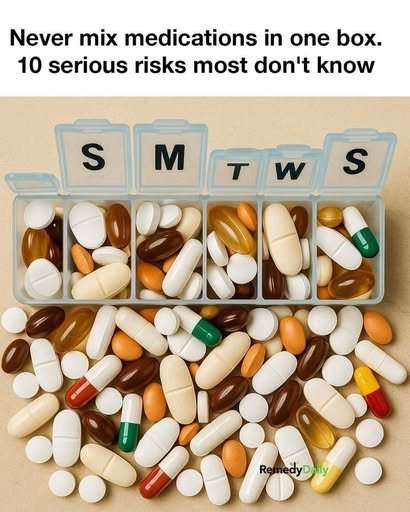
Keeping several medicines together may seem like a simple way to save space or make a daily routine easier. But putting different pills into the same unlabeled box, bottle, or container can create medication-safety problems that are easy to overlook.
The U.S. Food and Drug Administration (FDA) advises keeping medicines in their original labeled containers whenever possible and specifically says not to combine different medicines in the same bottle. Clear labeling helps you identify the correct medicine, strength, expiration information, and storage instructions when you need them.
Here are 10 important risks to understand before mixing medications in one container.
1. You Can Accidentally Take the Wrong Medicine
Many tablets and capsules look surprisingly similar.
If several different medicines are loose in one container, it may become difficult to determine which pill is which—especially in poor lighting, when you’re tired, or when you’re taking several medications.
A wrong pill can mean an ineffective dose or an unwanted reaction.
Better approach: Keep each medication clearly labeled and identifiable.
2. You Can Take the Wrong Strength
Some medications are available in multiple strengths that may look almost identical.
For example, a 5 mg tablet and a 10 mg tablet of the same medicine may have similar shapes or colors.
If different strengths are mixed together, you could unintentionally take twice the intended amount—or too little.
Always check the medication name and strength before taking a dose.
3. You May Lose Important Expiration Information
Medication packaging provides important information such as:
- Expiration date
- Medication name
- Strength
- Manufacturer
- Storage instructions
- Prescription information
When pills are removed from their original packaging and mixed together, that information may no longer be available for each individual tablet.
The FDA warns that expired medicines can become less effective or potentially harmful, depending on the medication and how it has been stored.
4. You May Forget Which Medicine Is Which
This is particularly concerning when someone takes several prescriptions every day.
A loose collection of white tablets may be impossible to identify confidently just by looking at them.
And guessing is not a safe medication strategy.
If you’re unsure what a pill is, don’t take it simply because you think you recognize it. Ask a pharmacist or healthcare professional for help identifying it.
5. Storage Requirements Can Be Different
Not every medication has the same storage requirements.
Some medicines need protection from:
- Heat
- Moisture
- Light
- Freezing temperatures
- Excessive humidity
Some medications may require refrigeration, while others should not be refrigerated unless specifically instructed.
The FDA recommends following the storage instructions provided with each medicine because improper storage can reduce effectiveness or potentially cause harm.
A single container may therefore be unsuitable for medications with different storage requirements.
6. You Can Lose the Original Label
The label isn’t just there to identify the pill.
It can tell you:
- How much to take
- How often to take it
- Whether to take it with food
- Important warnings
- Storage conditions
- Expiration information
- The patient’s name
Removing medicines from their labeled containers can make it much harder to check these instructions when you need them.
The FDA recommends maintaining an up-to-date medication list as well.
7. Medication Mix-Ups Become More Likely
Medication errors don’t only happen because pills look alike.
Drug names and packaging can also be confusingly similar. The Institute for Safe Medication Practices (ISMP) has documented medication errors involving medicines with similar names, strengths, or appearances. Separating medications and maintaining clear identification are important strategies for reducing mix-ups.
Keeping medicines separated makes it easier to verify what you’re taking.
8. You Could Give Someone Else the Wrong Medicine
This can become especially dangerous in households where several people take prescription medications.
Imagine several family members’ medicines being placed into the same container.
A person could easily assume a pill belongs to them and take it accidentally.
Prescription medicines should be used only by the person for whom they were prescribed. The FDA also advises against sharing medicines.
9. Children May Be at Greater Risk
Loose pills or mixed medications can create an additional poisoning hazard if children gain access to them.
Some tablets can look like candy, and children may not understand the difference.
The FDA recommends keeping medicines out of children’s sight and reach and using appropriate child-resistant packaging.
Never leave loose medication where children or pets can access it.
10. Emergency Identification Becomes Much Harder
Imagine becoming sick and needing medical treatment while your medicines are sitting loose in an unlabeled container.
Healthcare professionals may need to know exactly what medications you take, including their strengths and doses.
Keeping medicines properly labeled—and maintaining a current medication list—can make this information much easier to provide.
The FDA recommends keeping an up-to-date list of prescription medicines, over-the-counter medicines, vitamins, and supplements.
What About Pill Organizers?
A weekly pill organizer can be useful for some people, but it should not be confused with randomly mixing medications together.
If you use a pill organizer, first make sure your pharmacist or healthcare professional agrees that it is appropriate for your medicines. Some medications have special storage requirements or other reasons they should remain in their original packaging.
A pharmacist can also help determine whether your particular medicines can safely be placed into an organizer.
A Safer Way to Organize Medicines
Instead of putting everything into one box, consider:
- Keep medications in their original labeled containers whenever possible.
- Store medicines according to their individual instructions.
- Keep different people’s medications separate.
- Check the medication name and strength before every dose.
- Maintain a current medication list.
- Keep medicines away from children and pets.
- Regularly check expiration dates.
- Ask a pharmacist before transferring medication into another container.
The FDA specifically recommends original labeled containers and says different medicines should not be combined in the same bottle.
What If You Already Mixed Your Pills?
Don’t guess which pill is which.
If you can no longer reliably identify the medications, separate them only if you can do so confidently using the original packaging, prescription records, or other reliable identification information.
If you’re uncertain, take the container and original medication information to a pharmacist for identification.
If you think you have already taken the wrong medication or wrong dose and are experiencing concerning symptoms, seek urgent medical assistance or contact your local poison/emergency service.
Final Thoughts
Keeping medicines organized isn’t just about neatness. Clear identification is an important part of medication safety.
Different medications can have different doses, storage requirements, expiration dates, and instructions. Mixing loose pills together removes some of the information that helps you use them safely.
For most people, the safest habit is simple: keep each medication clearly labeled and separated, follow its storage instructions, and ask a pharmacist before changing how it is stored.
SEO Details
SEO Title: Never Mix Medications in One Box: 10 Serious Risks
Meta Description: Mixing medications in one container can cause dangerous mix-ups and dosing errors. Learn 10 medication-storage risks and safer ways to organize medicines.
Focus Keyword: never mix medications in one box
Related Keywords: medication safety, medication storage, storing pills safely, medication errors, pill organizer safety, prescription medication safety
Suggested URL Slug: never-mix-medications-in-one-box