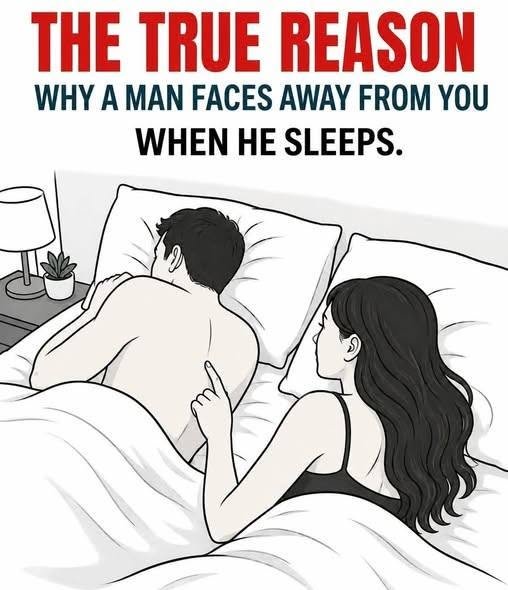
Have you ever gone to bed next to your partner, only to notice that they have turned their back toward you?
It can be surprisingly easy to overthink a small bedtime habit. You might wonder, “Are they upset with me?”, “Are they losing interest?”, or “Do they want more space?”
The truth is that sleeping position alone cannot tell you exactly how someone feels about their partner.
People change positions throughout the night for many reasons, including comfort, temperature, mattress space, back or neck position, breathing, and simple habit.
Still, turning away can sometimes be interesting when considered alongside the couple’s overall relationship and daytime behavior.
1. They May Simply Be More Comfortable That Way
The simplest explanation is often the correct one.
Some people naturally sleep on their side, and turning away from their partner may simply be their preferred sleeping position.
They may sleep better with their back supported or with more space around their shoulders and legs.
In this situation, turning away isn’t necessarily a sign of emotional distance.
2. They May Need More Personal Space
Even people in happy relationships sometimes need physical space while sleeping.
Sleeping isn’t the same as socializing.
Someone may love cuddling before bed but prefer to sleep independently once they’re actually trying to fall asleep.
If your partner turns away but remains affectionate, communicative, and connected during the day, their sleeping position may mean very little.
3. They Could Be Trying to Sleep More Comfortably
Temperature can make a surprisingly big difference.
If two people have different temperature preferences, one partner may turn away simply because they don’t want to share as much body heat.
The same can happen if one person moves frequently during sleep or prefers a particular position for their back, shoulders, or hips.
4. They May Have Become Used to the Position
Sleeping habits can become automatic.
A person who has slept on their side for years may turn onto the same side every night without consciously thinking about their partner.
In other words, not every nighttime behavior has a hidden emotional message.
5. They May Still Feel Close to You
Turning away doesn’t automatically mean someone is emotionally withdrawing.
Some couples sleep back-to-back and still feel deeply connected.
In fact, partners can maintain closeness through many different sleeping arrangements.
What matters more is the broader pattern of affection, communication, trust, and mutual respect.
6. They May Be Trying Not to Disturb You
Sometimes turning away is actually practical.
Your partner may be trying to avoid:
- Breathing directly toward you
- Snoring in your direction
- Moving their arms near your face
- Disturbing you while changing position
- Accidentally waking you
A sleeping position can therefore have a very ordinary explanation.
7. They Could Be Stressed or Tired
Stress can affect sleep behavior.
Someone experiencing a stressful day may simply want to get comfortable and fall asleep quickly.
That doesn’t necessarily mean they are angry with their partner.
If their behavior has changed suddenly and they’re also unusually withdrawn during the day, however, it may be worth checking in with them.
8. The Bigger Picture Matters More Than the Sleeping Position
One night doesn’t tell you much.
Even several nights may not tell you much.
Instead, look at the overall relationship.
Ask yourself:
- Do you communicate openly?
- Do you spend quality time together?
- Do you show affection?
- Do you feel respected?
- Can you discuss problems without fear?
- Do you support each other?
- Has there been a noticeable change in your partner’s behavior?
These questions provide much more meaningful information than whether someone faces left or right while sleeping.
What If Your Partner Suddenly Started Doing It?
A sudden change may naturally make you curious.
Perhaps your partner previously slept facing you and now consistently turns away.
Don’t immediately assume the worst.
There could be a physical reason, a change in sleep habits, stress, a different work schedule, discomfort, or simply a new preference.
The healthiest response is communication.
You could gently say:
“I’ve noticed you’ve been sleeping differently lately. Is everything okay?”
This opens the door for an honest conversation without making an accusation.
When Sleeping Positions May Reflect Relationship Problems
A sleeping position by itself isn’t reliable evidence of relationship trouble.
However, if turning away occurs alongside persistent emotional withdrawal, such as avoiding conversations, loss of affection, frequent conflict, or refusing to spend time together, it may be worth discussing what has changed.
Even then, the sleeping position isn’t the proof of a problem.
The important information comes from the broader behavior and the conversation between the two partners.
What Different Sleeping Positions Are Sometimes Said to Mean
You may have seen claims online that every couple’s sleeping position reveals their relationship.
For example:
Facing each other: Often described as intimacy or connection.
Back-to-back: Sometimes described as independence or comfort.
One partner embracing the other: Often associated with affection.
Large physical distance: Sometimes interpreted as emotional distance.
These descriptions can be interesting, but they should not be treated as scientific relationship tests.
People sleep according to comfort, habits, temperature, physical health, mattress size, and countless other factors.
Don’t Diagnose Your Relationship From the Bed
This may be the most important lesson.
A partner turning their back toward you while sleeping doesn’t automatically mean they don’t love you, are angry with you, or are losing interest.
Likewise, cuddling all night doesn’t automatically prove that a relationship is perfect.
Healthy relationships are better understood through communication and consistent behavior while both people are awake.
Final Thoughts
If your partner turns their back on you while sleeping, don’t panic or immediately assume something is wrong.
They may simply be comfortable that way.
They may want more space, be too warm, be following an old sleeping habit, or be trying to get a better night’s sleep.
If you’re genuinely concerned—especially if you’ve noticed other changes in the relationship—the best approach isn’t to analyze their sleeping position.
Talk to them.
A calm conversation can tell you far more about your relationship than any viral body-language theory ever could.
Frequently Asked Questions
Does sleeping with your back toward your partner mean they are angry?
Not necessarily. Sleeping position alone isn’t a reliable way to determine someone’s emotions.
Does turning away mean a partner has lost interest?
No. There are many ordinary reasons people change sleeping positions, including comfort, temperature, habit, and physical discomfort.
Is sleeping back-to-back a bad sign?
Not by itself. Many couples naturally sleep back-to-back and remain emotionally close.
Should I ask my partner about it?
If the change concerns you, a calm and non-accusatory conversation is usually more useful than trying to interpret the sleeping position.
What matters more than sleeping position?
Communication, affection, trust, respect, emotional connection, and how partners treat each other throughout their everyday lives.
SEO Details
SEO Title: If Your Partner Turns Their Back on You While Sleeping, What Does It Mean?
Meta Description: Does your partner turn their back on you while sleeping? Discover the possible reasons behind this common sleeping habit and why it doesn’t necessarily mean emotional distance.
Focus Keyphrase: partner turns their back while sleeping
Related Keywords: sleeping positions couples, partner sleeping with back turned, relationship sleeping positions, couples sleeping habits, sleeping back to back, relationship body language
Suggested URL Slug: partner-turns-back-while-sleeping
Featured Image Alt Text: Couple sleeping peacefully in different positions in bed
Category: Relationships & Lifestyle
Tags: Relationships, Couples, Sleeping Habits, Relationship Tips, Lifestyle, Communication