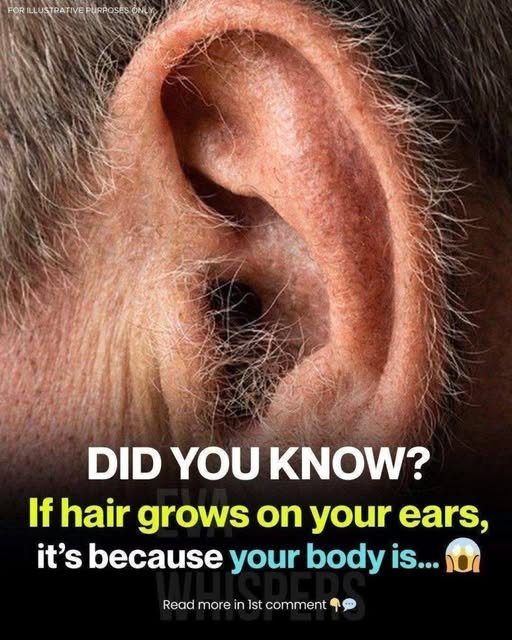
Have you ever noticed a few hairs growing around or inside your ears and wondered whether they mean something about your health?
Ear hair is completely normal. Some people have barely noticeable fine hairs, while others develop thicker or darker hair around the outer ear as they get older.
Although viral health claims sometimes suggest that ear hair is a warning sign of heart disease, high testosterone, or another serious condition, ear hair by itself cannot diagnose a medical problem.
Still, understanding why ear hair develops can tell you something interesting about aging, hormones, genetics, and normal changes in the body.
Why Do We Have Ear Hair?
Hair follicles are naturally present around the ears, just as they are on many other parts of the body.
Fine hairs can help protect the skin by providing a small physical barrier against dust and other particles.
As people age, some previously fine or barely visible hairs can become thicker, longer, or darker.
This happens because hair follicles can become more sensitive to hormonal signals over time.
1. Ear Hair Often Becomes More Noticeable With Age
One of the most common explanations for increased ear hair is simply aging.
As men get older, coarse hair may become more noticeable around areas such as:
- The ears
- Nose
- Eyebrows
- Eyelids
- Chin
Women can also develop increased facial or ear hair, particularly as hormone levels change with age.
So if you suddenly notice a few more hairs around your ears later in life, it isn’t necessarily a sign that something is wrong.
2. Genetics Plays a Major Role
Your genes influence where your body grows hair, how thick it becomes, and how quickly it grows.
If close family members have noticeable ear or facial hair, you may be more likely to develop it too.
This is one reason two people of the same age can have completely different amounts of visible ear hair.
3. Hormones Can Influence Hair Growth
Androgens, including testosterone and related hormones, influence hair growth in many areas of the body.
Changes in hormone levels or sensitivity can alter the thickness and distribution of body hair.
However, ear hair alone is not a reliable way to determine whether testosterone levels are high or low.
If abnormal hair growth occurs suddenly along with other symptoms—such as significant changes in body hair, acne, menstrual irregularities, or other hormonal changes—a healthcare professional can evaluate the situation properly.
4. Does Ear Hair Mean You Have Heart Disease?
This is one of the most persistent claims you’ll see online.
Some observational studies have investigated an association between diagonal earlobe creases and cardiovascular disease, while other research has looked at body hair patterns.
But these observations do not mean that having hairy ears causes heart disease—or that ear hair can be used as a diagnostic test.
Heart health should be assessed using established risk factors and medical evaluations, including blood pressure, cholesterol, blood sugar, smoking status, family history, physical activity, and other relevant factors.
If you have concerns about your heart health, don’t rely on the appearance of your ears.
5. Ear Hair Is Not a Sign of Poor Hygiene
Another common misconception is that visible ear hair means someone isn’t taking care of themselves.
That’s simply not true.
Hair growth is largely influenced by genetics, age, hormones, and individual biology.
You can have excellent personal hygiene and still develop noticeable ear hair.
6. Should You Remove Ear Hair?
If ear hair bothers you cosmetically, there are several ways to manage it.
For hair on the outer ear, careful trimming with a small electric trimmer is generally preferable to aggressive methods.
Avoid inserting sharp objects deep into the ear canal.
The ear canal is delicate, and unnecessary manipulation can cause scratches, irritation, infection, or even injury to the eardrum.
Be Careful With Ear Candling
Ear candling is sometimes promoted as a way to clean the ear or remove hair and wax.
It isn’t a safe method.
Burns, blockage, and ear injuries can occur, and there is no good reason to put a burning candle near the ear.
If you have excessive earwax, hearing problems, or a blocked sensation, use an appropriate medical approach rather than inserting objects into the ear.
When Should You Talk to a Doctor?
Ear hair itself usually isn’t something that requires medical attention.
However, it is worth discussing unusual changes with a healthcare professional if hair growth is:
- Very sudden or dramatic
- Occurring along with other significant hormonal symptoms
- Accompanied by unexplained skin changes
- Associated with persistent itching, pain, swelling, or a skin lesion
A doctor can determine whether the change is simply normal hair growth or whether another condition needs to be considered.
What Actually Matters More for Your Health?
Instead of trying to read your health from ear hair, pay attention to measurable health indicators.
Regularly monitoring things such as:
- Blood pressure
- Blood glucose when appropriate
- Cholesterol
- Weight and waist circumference
- Physical activity
- Diet quality
- Sleep
- Smoking and alcohol habits
provides far more useful information about your overall health.
Final Thoughts
Ear hair may become more noticeable as you age, and genetics and hormones can influence how much grows. In most cases, it is simply a normal variation in body hair—not a secret warning sign of a serious disease.
Claims that hairy ears automatically indicate heart disease, high testosterone, or another medical condition are far too simplistic.
If you don’t like the appearance, carefully trimming the hair on the outer ear is usually enough. But if you notice sudden changes accompanied by other symptoms, talk with a healthcare professional rather than trying to diagnose yourself based on hair growth alone.