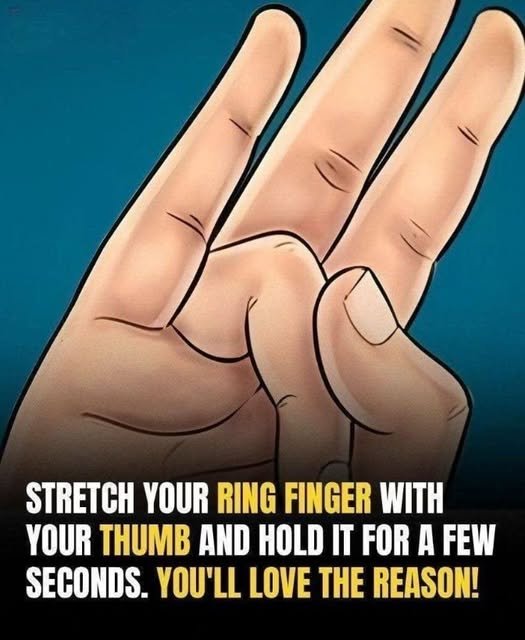
You may have seen the claim that stretching your ring finger with your thumb and holding it for a few seconds can produce a surprising health effect. These kinds of hand exercises are often shared online alongside claims about organs, circulation, stress, blood pressure, or other health conditions.
But what is really happening when you gently stretch a finger?
The most straightforward explanation is much less mysterious: finger stretching moves the joints and surrounding soft tissues, including muscles and tendons, and may help maintain flexibility and reduce stiffness.
Hand-therapy resources commonly use controlled finger stretches and tendon-gliding exercises to maintain or improve finger movement, particularly when stiffness is present.
That doesn’t mean a ring-finger stretch is a treatment for an internal medical condition. The specific claims sometimes attached to this technique should be treated cautiously.
What Happens When You Stretch Your Ring Finger?
When you use your thumb and another finger to gently stretch the ring finger, you’re moving several small structures in the hand.
These include:
- Finger joints
- Tendons
- Small muscles
- Ligaments and connective tissues
- The skin and surrounding soft tissues
A gentle stretch can produce a feeling of tension or pulling. With regular, appropriate hand exercises, movement can help prevent or reduce stiffness.
Hand-therapy guidance describes controlled finger stretches as a way to keep the joints, muscles, and tendons active and maintain range of motion.
Why Does It Feel Different When You Stretch the Ring Finger?
Each finger has its own combination of joints, tendons, and connections with the muscles of the hand.
The ring finger may therefore feel different from the index finger or little finger when you bend or stretch it.
You might notice:
- A mild pulling sensation
- Temporary tightness
- A feeling of increased mobility
- Mild tension in the palm
- A gentle stretch through the finger
These sensations generally reflect the mechanical movement of the hand rather than evidence that the exercise is affecting a particular internal organ.
Can This Stretch Improve Circulation?
Gentle movement of the hands can increase local muscle activity and movement around the joints, but that should not be confused with a treatment for poor circulation throughout the body.
There is also a popular idea that specific points on the hands correspond to particular organs and that pressing or stretching those points can heal those organs.
Those claims are associated with practices such as reflexology or traditional medicine. According to the National Center for Complementary and Integrative Health, claims that specific hand or foot points correspond to other body parts and produce healing effects have not been proven.
So while a hand stretch may feel relaxing, it shouldn’t be presented as a way to “cleanse” an organ, unblock blood vessels, or cure a disease.
Could It Help With Stiff Fingers?
This is where the exercise has a more reasonable explanation.
Gentle finger exercises are commonly used in hand therapy to help maintain movement and address stiffness.
For example, NHS hand-therapy guidance includes exercises that involve gently bending and straightening individual finger joints and holding certain positions for several seconds.
Passive finger-stretching guidance also recommends slow, controlled stretches to help keep the joints, muscles, and tendons active.
However, the correct exercise depends on why the finger is stiff. Someone recovering from an injury or tendon repair should follow the exercises prescribed by their clinician rather than copying a random online technique.
How to Try a Gentle Ring-Finger Stretch
If you simply want to maintain comfortable finger mobility, you can try a gentle version.
Step 1: Relax Your Hand
Place your hand in a comfortable position with your fingers relaxed.
Step 2: Hold the Ring Finger
Use the thumb and index finger of your opposite hand to gently hold the ring finger.
Step 3: Slowly Stretch
Move the ring finger gently toward a comfortable stretched position.
Do not force the joint or try to make it “pop.”
Step 4: Hold Briefly
Hold the comfortable stretch for several seconds, then slowly release.
Step 5: Relax
Return the finger to its natural position.
You can repeat the movement gently if it remains comfortable.
The goal should be comfortable mobility, not maximum stretching.
What Should You Feel?
A gentle pulling or stretching sensation can be normal.
You should not deliberately push through:
- Sharp pain
- Strong pressure
- Numbness
- Tingling
- Burning
- Sudden weakness
- Significant swelling
Hand-therapy guidance specifically recommends reducing the intensity or stopping when an exercise produces sharp or significant pain.
Does Holding the Finger for a Few Seconds Have a Special Health Meaning?
There is no established medical rule that holding the ring finger for a particular number of seconds produces a specific whole-body health effect.
The duration of a stretch can vary depending on the exercise and its purpose. Some clinical hand-therapy programs use five-second holds for particular movements, while passive stretching instructions may use longer holds such as 10–30 seconds.
Therefore, claims such as “hold your ring finger for five seconds and your blood pressure will drop” or “this activates a specific organ” should not be treated as established medical facts without strong clinical evidence.
What About Acupressure and Traditional Finger Exercises?
Finger exercises have been incorporated into some traditional and mind-body practices.
A recent review described finger exercises involving movements, massage, pressure techniques, stretching, and mindfulness. The authors reported promising but still limited evidence and emphasized the need for further research.
This is important because a practice can be relaxing or useful for hand mobility without proving that it treats a particular disease.
Traditional explanations and modern medical explanations are not necessarily the same thing.
When a Finger Problem Needs Medical Attention
A simple stretch is not appropriate for every hand problem.
Consider getting medical advice if you have:
- Persistent finger pain
- Significant swelling
- A finger that suddenly becomes difficult to move
- Numbness or persistent tingling
- Loss of grip strength
- A finger that becomes locked or catches repeatedly
- Recent trauma or a suspected fracture
- Sudden changes in finger color or temperature
People recovering from tendon injuries or surgery should follow their hand therapist’s specific exercise program because excessive or inappropriate exercise can interfere with healing.
The Bottom Line
Stretching your ring finger with your thumb and holding it briefly is best understood as a simple hand-mobility or stretching movement, not a secret diagnostic test or miracle health treatment.
Gentle finger exercises can help maintain movement and may be useful for stiffness in appropriate situations. Clinical hand-therapy programs use controlled stretching and tendon exercises for this purpose.
What isn’t established is the idea that one particular ring-finger stretch can directly treat an internal organ, dramatically improve circulation, lower blood pressure, remove toxins, or cure disease.
If the movement feels comfortable, it can be a simple addition to a general hand-mobility routine. If it causes pain, numbness, swelling, or unusual symptoms, stop rather than forcing the stretch.
SEO Details
SEO Title: Stretch Your Ring Finger With Your Thumb — What Does It Really Do?
Meta Description: Learn what happens when you gently stretch your ring finger with your thumb, what benefits may be realistic, and which popular health claims lack evidence.
Focus Keyword: ring finger stretch
Slug: ring-finger-stretch-with-thumb
Category: Health & Wellness
Tags: ring finger stretch, finger exercises, hand exercises, finger stretching, hand flexibility, hand stiffness, finger mobility, hand health, natural wellness, healthy hands