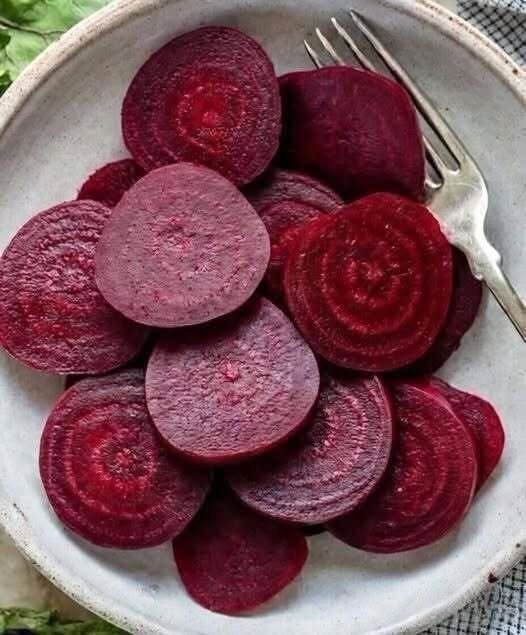
The Beetroot Upgrade: What Happens to Your Body When You Eat Beets, According to Doctors
Beetroot is more than a colorful addition to salads. It contains dietary nitrates, fiber, folate, potassium, and antioxidant compounds called betalains, making it a nutritious vegetable that can fit easily into a balanced diet.
Research has particularly focused on beetroot’s naturally occurring nitrates and their potential effects on blood pressure and blood-vessel function. (PubMed)
1. Your Blood Vessels May Relax
One of the most interesting properties of beetroot is its nitrate content.
Your body can convert dietary nitrate into nitrite and then nitric oxide. Nitric oxide helps blood vessels relax and widen, which may improve blood flow.
Clinical research on beetroot juice has found modest reductions in blood pressure, particularly systolic blood pressure. A 2024 meta-analysis of 11 randomized trials in people with hypertension found an average reduction of about 5.3 mmHg in clinical systolic blood pressure, although the researchers rated the certainty of the evidence as low. (PubMed)
2. It May Support Healthy Blood Pressure
Regularly including beetroot in your diet may be helpful as part of an overall heart-healthy eating pattern.
Earlier systematic reviews have also reported modest reductions in blood pressure after beetroot juice supplementation. However, beetroot should be viewed as a food that may support cardiovascular health—not a replacement for prescribed blood-pressure medication. (PubMed)
3. You Get Plenty of Plant Compounds
Beets contain naturally occurring pigments called betalains, along with other phytochemicals such as flavonoids and polyphenols.
These compounds contribute to beetroot’s deep red-purple color and antioxidant activity. (PubMed Central (PMC))
Eating whole beetroot also gives you fiber, which is generally beneficial for digestive health and helps make meals more filling.
4. Your Exercise Performance May Benefit
Beetroot’s dietary nitrates have also been studied in relation to physical performance because nitric oxide is involved in blood flow and oxygen utilization.
The effects aren’t identical for everyone, and beetroot isn’t a magic performance enhancer, but nitrate-rich beetroot products have been studied extensively in sports nutrition.
5. Your Digestion Gets Some Extra Fiber
Whole beetroot contains dietary fiber, which contributes to normal bowel function.
For this reason, whole cooked or raw beetroot can be a more nutritionally complete choice than relying exclusively on beetroot juice, because juicing removes much of the vegetable’s fiber.
6. Your Urine or Stool May Turn Red
Don’t be alarmed if you notice reddish or pink urine or stool after eating beets.
This phenomenon, often called beeturia, can occur because of beetroot pigments and is generally harmless.
However, if you see unexplained blood in your urine or stool when you haven’t recently eaten beets, don’t automatically assume it’s from beetroot—get it checked by a healthcare professional.
How Much Beetroot Should You Eat?
There’s no universally established “medical dose” of whole beetroot for general health.
A practical approach is simply to include a moderate serving of beetroot as part of a varied diet.
You can enjoy it:
- Roasted with olive oil and herbs
- Grated into salads
- Boiled and sliced
- Blended into smoothies
- Added to soups
- Served with yogurt and herbs
- Mixed into grain or chicken bowls
Research involving beetroot juice has used considerably different amounts and nitrate concentrations, so those study doses shouldn’t automatically be treated as a recommended daily dose for everyone. (PubMed Central (PMC))
A Simple Beetroot Upgrade
For an easy everyday version, try:
Roasted Beetroot + Greek Yogurt + Lemon + Feta
Roast sliced beetroot until tender, then serve it over plain Greek yogurt with crumbled feta, fresh lemon juice, black pepper, and a drizzle of olive oil.
It’s an easy way to combine beetroot with protein, healthy fats, and other nutritious foods.
A Few Things to Keep in Mind
If you already have low blood pressure or take blood-pressure medication, don’t start consuming large amounts of concentrated beetroot juice specifically to lower your blood pressure without discussing it with your healthcare professional.
Also, people prone to certain types of kidney stones, particularly calcium oxalate stones, may need to moderate high-oxalate foods such as beets depending on their individual medical advice.
Bottom Line
Beetroot isn’t a miracle food or a detox treatment. But it is a nutrient-rich vegetable, and its naturally occurring nitrates may modestly support blood pressure and cardiovascular function. The strongest evidence currently concerns beetroot juice and blood pressure, while the benefits of simply eating beets should be understood as part of an overall healthy diet. (PubMed)
The real beetroot upgrade isn’t a secret cure—it’s making a colorful, nutrient-rich vegetable a regular part of a balanced diet.