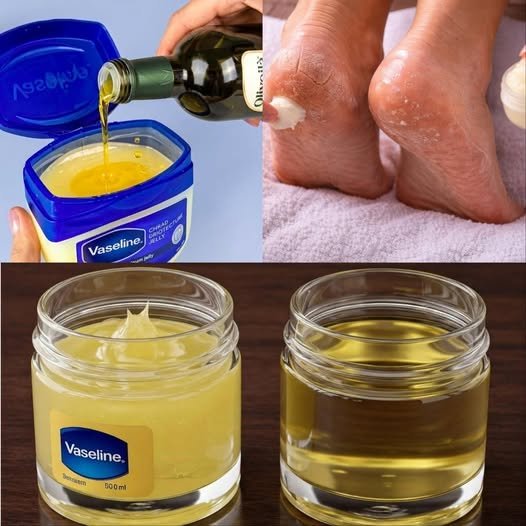
Dry, rough heels can make your feet feel uncomfortable and can leave the skin looking cracked, flaky, and neglected. If you spend a lot of time standing, walk barefoot frequently, or live in a dry climate, your heels may lose moisture faster than the rest of your skin.
A simple combination of olive oil and Vaseline can help soften and moisturize dry heel skin. It isn’t a miracle cure, but the two ingredients work well as a basic overnight moisturizing treatment.
Olive oil provides emollient properties, while Vaseline, which contains petrolatum, forms an occlusive layer that helps reduce moisture loss from the skin. Used correctly, this combination can leave rough feet feeling noticeably softer.
Why Olive Oil and Vaseline Can Help
Olive Oil
Olive oil contains fatty acids and other compounds that can help condition the skin. Applied externally, it can make dry skin feel softer and smoother.
However, olive oil isn’t necessarily the best moisturizer for everyone. Some people with sensitive or eczema-prone skin may find certain oils irritating, so it’s wise to test a small area first.
Vaseline
Vaseline is primarily an occlusive moisturizer. Rather than adding large amounts of water to the skin, it creates a protective layer that slows water loss.
This makes petrolatum particularly useful for areas that become extremely dry, such as:
- Heels
- Elbows
- Knees
- Hands
- Dry patches on the legs
Combining a small amount of olive oil with Vaseline can create a rich treatment for rough, dry feet.
How to Make the Olive Oil and Vaseline Heel Treatment
Ingredients
- 1 teaspoon olive oil
- 1 teaspoon Vaseline or plain petroleum jelly
Directions
- Wash your feet with lukewarm water and a gentle cleanser.
- Pat your feet dry, but leave the skin slightly damp.
- Mix the olive oil and Vaseline in a small clean container.
- Apply a thin layer to your heels and other dry areas.
- Massage gently for a minute or two.
- Put on a clean pair of cotton socks.
- Leave the treatment on overnight.
- Wash your feet normally the following morning if desired.
You can repeat this routine several nights a week while your heels are particularly dry.
For Better Results, Start With Damp Skin
One of the simplest ways to improve a heel-care routine is to apply moisturizer shortly after bathing.
When the skin is slightly damp, applying an occlusive product such as Vaseline can help trap some of that moisture.
You don’t need to soak your feet for a long time. A short lukewarm shower or bath followed by moisturizing is enough.
What to Do About Thick, Hard Skin
If your heels have a buildup of thick skin, moisturizing alone may take time.
After bathing, you can gently use a pumice stone or foot file to remove some loose dead skin.
Don’t aggressively scrape the heels or try to remove all the thick skin at once. Excessive filing can cause irritation and small injuries, which can make the problem worse.
A better approach is gentle exfoliation followed by consistent moisturizing.
Can This Treatment Heal Deep Cracks?
It may help soften dry, superficial cracked skin, but deep heel fissures require more care.
If cracks are:
- Deep or painful
- Bleeding
- Red or swollen
- Warm to the touch
- Producing discharge
- Getting worse instead of better
it’s better to have them evaluated by a healthcare professional.
People with diabetes or reduced sensation in their feet should be especially careful with foot cracks and wounds and should seek professional advice rather than relying solely on home treatments.
A Simple Weekly Foot-Care Routine
For consistently softer heels, try making foot care a regular habit.
Step 1: Clean
Wash your feet with lukewarm water and a gentle cleanser.
Step 2: Dry Carefully
Pat your feet dry, especially between the toes.
Step 3: Gently Exfoliate
Once or twice a week, gently remove loose, thickened skin with a pumice stone or foot file.
Step 4: Moisturize
Apply a fragrance-free moisturizer to the feet and heels.
Step 5: Seal in Moisture
Apply a thin layer of Vaseline over particularly dry areas.
Step 6: Wear Cotton Socks
Putting on clean socks overnight helps keep the moisturizer in place and prevents it from rubbing off on bedding.
A Useful Alternative: Vaseline Over Moisturizer
You don’t necessarily need olive oil at all.
For very dry heels, a simple routine of applying a moisturizing cream or lotion first and then using a thin layer of Vaseline on top can be highly effective.
Look for foot creams containing ingredients such as:
- Urea
- Lactic acid
- Ceramides
- Glycerin
These ingredients can provide additional benefits for rough or excessively dry skin.
Important Safety Tips
Don’t apply the mixture between your toes if the area tends to remain damp. Excess moisture between the toes can contribute to fungal problems.
Also remember that Vaseline makes skin slippery. Be careful when walking barefoot immediately after applying it, particularly on smooth bathroom floors.
Avoid applying oils or petroleum jelly to an actively infected, severely inflamed, or open wound without appropriate medical advice.
What You Shouldn’t Expect
Olive oil and Vaseline can moisturize and soften dry skin, but they cannot:
- Permanently remove scars
- Cure fungal infections
- Instantly repair deep wounds
- Permanently eliminate cracked heels after one application
- Change your natural skin color
- Replace treatment for an underlying medical condition
The biggest benefit comes from consistent moisturizing and protecting the skin from excessive dryness.
Final Thoughts
Mixing olive oil with Vaseline can be a simple and inexpensive way to care for dry, rough heels. Olive oil helps condition the skin, while Vaseline creates a protective barrier that reduces moisture loss.
For the best results, apply the mixture to slightly damp skin, use it consistently, and consider wearing clean cotton socks overnight.
It may not be the “miracle” treatment viral posts sometimes promise, but as part of a regular foot-care routine, this simple combination can help make dry heels feel softer, smoother, and more comfortable.