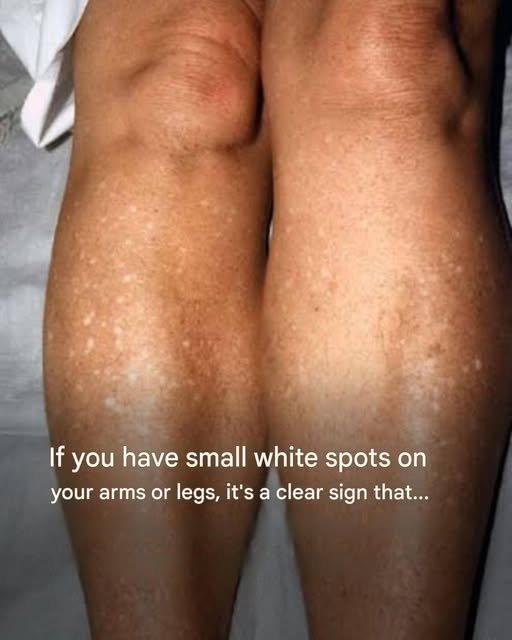
If You Have Small White Spots on Your Arms or Legs, It Could Be a Sign of Several Skin Conditions
Have you ever noticed tiny white spots appearing on your arms or legs and wondered why they’re there?
These spots can be easy to ignore, especially when they don’t itch, hurt, or cause any other symptoms. But changes in skin color can have several different causes. Some are harmless and common, while others may need evaluation by a dermatologist.
Importantly, small white spots are not a clear sign of one specific disease or deficiency. Their appearance, location, texture, and how quickly they develop can provide important clues.
Here are some of the more common possibilities.
1. Idiopathic Guttate Hypomelanosis
One common cause of small, flat white spots—particularly on the arms and legs—is idiopathic guttate hypomelanosis (IGH).
These spots are usually:
- Small and round or oval
- Flat rather than raised
- Lighter than the surrounding skin
- Usually not painful or itchy
- More noticeable after tanning because the surrounding skin becomes darker
IGH becomes more common with age and is often associated with cumulative sun exposure. It is generally considered harmless.
The spots may be easier to notice on areas that receive regular sunlight, such as the forearms and lower legs.
2. Vitiligo
Another possibility is vitiligo, a condition in which areas of skin lose pigment.
Vitiligo can begin as small pale patches and gradually become more noticeable. The patches are often smooth and sharply defined.
They may occur on the:
- Hands
- Face
- Arms
- Legs
- Around the eyes or mouth
- Other parts of the body
Vitiligo can also affect hair in the affected area.
Not every white spot is vitiligo, but new or progressively enlarging areas of pigment loss are worth having examined by a dermatologist.
3. A Previous Rash or Skin Injury
Sometimes a white or lighter mark appears after another skin problem has healed.
This can happen after:
- Eczema
- Inflammation
- Minor injuries
- Scratches
- Burns
- Certain infections
This is known as post-inflammatory hypopigmentation.
The original rash may have disappeared, leaving behind an area that is temporarily lighter than the surrounding skin.
In many cases, pigmentation gradually becomes more even over time.
4. Fungal Skin Infections
Some superficial fungal infections can cause lighter or darker patches on the skin.
For example, tinea versicolor can produce patches that appear lighter than the surrounding skin, although they may also look pink, tan, or brown depending on the person’s natural skin tone.
The patches may have fine scaling and can sometimes be mildly itchy.
Tinea versicolor is more commonly found on the trunk, chest, shoulders, and upper arms than on the lower legs.
Because fungal infections require different treatment from pigment disorders, it’s better not to assume every light-colored patch is caused by fungus.
5. Dry Skin
Very dry skin can sometimes make areas appear pale, flaky, or uneven in color.
If the spots are accompanied by roughness, scaling, or itching, moisturizing regularly may help.
However, persistent sharply defined white patches should not automatically be attributed to dryness.
6. Nutritional Problems
People sometimes assume that white spots automatically mean the body is lacking calcium, vitamins, or another nutrient.
That’s not necessarily true.
Most small, localized white spots on the skin are not automatically evidence of a vitamin or mineral deficiency.
Nutritional deficiencies can affect the skin in various ways, but a doctor would usually consider the person’s overall symptoms, diet, medical history, and sometimes blood tests before identifying a deficiency.
Taking supplements simply because white spots appeared is therefore not a good diagnostic strategy.
Does Sun Exposure Cause White Spots?
Sun exposure can make existing pale spots much easier to notice because the surrounding skin becomes darker.
Long-term sun exposure is also associated with some forms of pigment change, including idiopathic guttate hypomelanosis.
This is one reason protecting your skin from excessive ultraviolet exposure is important.
Using broad-spectrum sunscreen, wearing protective clothing, and seeking shade during strong sunlight can help protect your skin.
When Should You See a Dermatologist?
Consider getting the spots checked if they:
- Are rapidly increasing in number
- Are spreading or becoming larger
- Have very sharp borders
- Appear on several different parts of the body
- Are accompanied by scaling or persistent itching
- Develop after a significant rash or injury
- Affect the hair or eyebrows in the same area
- Are associated with other unusual skin changes
A dermatologist can often narrow down the cause by examining the skin directly. In some cases, additional tests may be necessary.
What You Shouldn’t Do
Avoid aggressively scrubbing white spots or applying random bleaching, antifungal, steroid, or home-remedy products without knowing what you’re treating.
Different skin conditions can look surprisingly similar but require completely different treatments.
Trying the wrong product may irritate the skin and make the color difference more noticeable.
The Bottom Line
Small white spots on your arms or legs are not a clear sign of one particular disease. They can be caused by harmless pigment changes such as idiopathic guttate hypomelanosis, vitiligo, previous inflammation, certain fungal infections, or other skin conditions.
The most useful clues are the size, shape, location, texture, duration, and whether the spots are changing.
If the spots are new, spreading, or becoming more noticeable, a dermatologist can help determine exactly what you’re dealing with instead of relying on a viral health claim or home remedy.