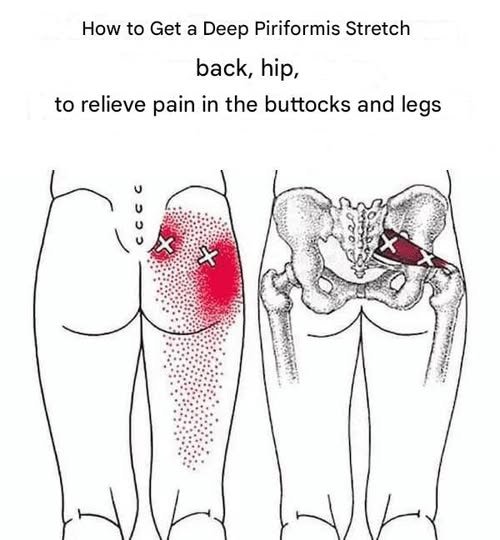
A tight or irritated piriformis muscle can contribute to discomfort in the buttock and hip area and, in some people, irritation around the sciatic nerve. Gentle stretching may help improve mobility and temporarily reduce muscle-related discomfort.
However, a piriformis stretch cannot eliminate every type of back, hip, glute, or leg pain. Similar symptoms can come from a herniated disc, spinal stenosis, arthritis, nerve compression, muscle injury, or other conditions. The goal is to use stretching safely rather than assume the piriformis is always the cause.
The Seated Figure-Four Piriformis Stretch
This is one of the simplest ways to gently target the muscles around the outer hip and buttock.
Step 1: Sit on a Stable Chair
Sit upright with both feet flat on the floor.
Keep your shoulders relaxed and your spine in a comfortable neutral position.
Step 2: Cross One Ankle Over the Opposite Knee
Lift your right foot and place your right ankle over your left thigh.
Your right knee should naturally move outward.
Don’t force the knee downward.
Step 3: Lean Forward Slowly
Keeping your back relatively straight, gently hinge forward from your hips.
You should feel a mild stretch in the outer hip or buttock of the crossed leg.
You should not feel sharp, burning, or electric pain traveling down your leg.
Step 4: Hold the Position
Hold for approximately 20–30 seconds, breathing slowly.
Relax, return to the starting position, and repeat 2–3 times on each side.
A Lying Figure-Four Stretch
You can also perform a similar stretch while lying on your back.
- Lie comfortably on your back with both knees bent.
- Place your right ankle over your left thigh.
- Reach behind your left thigh.
- Gently draw the left thigh toward your chest.
- Stop when you feel a comfortable stretch around the right buttock.
- Hold for 20–30 seconds.
- Slowly release and repeat on the other side.
Keep the movement controlled rather than pulling aggressively.
Don’t Chase a “Deep” Stretch
A common mistake is assuming that the deeper the stretch, the better the result.
That’s not necessarily true.
A good stretch should feel like gentle tension, not severe pain. Pulling aggressively can irritate muscles, joints, or nerves and potentially make symptoms worse.
If you experience tingling, numbness, burning, or an electric sensation traveling down the leg, ease off the stretch.
Add Gentle Movement
Stretching may work better as part of a broader mobility routine.
After warming up, you might include:
- Gentle walking
- Hip mobility exercises
- Glute strengthening
- Controlled bridges
- Gentle bodyweight exercises
- Regular changes of position if you sit for long periods
Strengthening the hips and glutes can be particularly useful when weakness or poor movement patterns contribute to discomfort.
How Often Should You Stretch?
For general flexibility, you can try gentle piriformis stretching once or twice a day, provided it feels comfortable.
Consistency is more important than forcing an extremely deep stretch.
If your symptoms become worse after stretching, stop and reassess rather than continuing through the pain.
When Piriformis Stretching May Not Be Appropriate
Not all pain in the buttock or leg comes from the piriformis.
Pain that travels down the leg may involve irritation of a spinal nerve. Other conditions can also produce similar symptoms.
You should consider professional evaluation if pain:
- Persists or repeatedly returns
- Is getting worse
- Causes persistent numbness or tingling
- Produces weakness in the leg or foot
- Makes walking difficult
- Started after a significant injury
- Interferes with sleep or normal daily activities
Seek Urgent Medical Care for Red-Flag Symptoms
Back pain with new loss of bladder or bowel control, numbness around the groin or inner thighs, or significant/progressive weakness in the legs requires urgent medical assessment.
Likewise, sudden severe leg weakness or neurological symptoms should not be treated simply by stretching.
Final Thoughts
A gentle figure-four stretch can be a useful way to work on hip and buttock flexibility, and it may provide temporary relief when muscle tightness is contributing to discomfort.
But there is no single stretch that can guarantee elimination of back, hip, glute, or leg pain. Use gentle movements, avoid forcing the stretch, and pay attention to symptoms that suggest a different underlying problem.
If pain is persistent, severe, or accompanied by numbness or weakness, finding the underlying cause is more important than trying to stretch deeper.