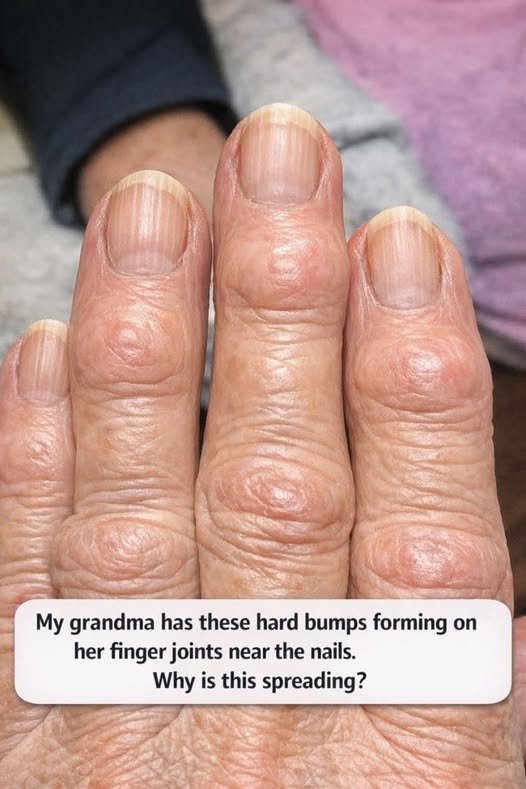
If your grandma has started developing hard bumps on the finger joints closest to her nails, it may look concerning at first. In older adults, one common explanation is a type of hand osteoarthritis that can cause bony enlargements around the end joints of the fingers.
These bumps are often called Heberden’s nodes. They can develop gradually as the cartilage and other tissues around a joint change over time.
However, not every lump near a fingernail is caused by arthritis. Cysts, previous injuries, inflammation, and other conditions can produce similar-looking bumps. That’s why the location, texture, symptoms, and changes over time are important.
What Are Heberden’s Nodes?
Heberden’s nodes are firm, bony enlargements that develop around the distal interphalangeal (DIP) joints—the joints closest to the fingertips and fingernails.
They are associated with osteoarthritis of the hands.
The bumps may initially appear during periods when the joint is painful or swollen, and they can eventually become hard and permanent as the joint changes.
Some people have noticeable nodes without much pain, while others experience aching, tenderness, stiffness, or difficulty using the affected finger.
Why Do These Bumps Develop?
Osteoarthritis involves changes in the tissues of a joint, including deterioration of cartilage and remodeling of the underlying bone.
As the joint changes, the body can form additional bone around the edges of the joint. This can contribute to the characteristic knobby appearance of osteoarthritis in the fingers.
Age is one risk factor, but osteoarthritis isn’t simply something that happens to everyone as they get older.
Other factors can include:
- Previous finger injuries
- Repeated stress on the joints
- Family history
- Certain joint abnormalities
- Other forms of arthritis
Where Do Heberden’s Nodes Appear?
The easiest way to recognize their typical location is to look at the finger joints.
The DIP joint is the joint closest to the fingernail.
Heberden’s nodes form around these end joints.
A different type of bony enlargement called a Bouchard’s node affects the middle finger joints, known as the proximal interphalangeal (PIP) joints.
A person can have one type or both.
What Do They Feel Like?
Heberden’s nodes are usually:
- Firm or hard
- Located around the end finger joints
- Sometimes knobby or irregular
- Often slow to develop
- Sometimes present on multiple fingers
During an active flare of osteoarthritis, the area may become more tender, swollen, or stiff.
Over time, the visible enlargement may remain even if the pain becomes less noticeable.
Another Possibility: A Digital Mucous Cyst
A lump near the end finger joint doesn’t automatically mean it is a Heberden’s node.
A digital mucous cyst, also called a digital myxoid cyst, is another possibility.
These are typically small, fluid-filled lumps that occur near the last joint of a finger and are frequently associated with osteoarthritis.
Unlike a hard bony node, a mucous cyst may feel more like a distinct, rounded lump.
It can sometimes press against the nail and cause a groove or indentation in the nail.
How Can You Tell the Difference?
Appearance alone isn’t always enough, but there are some clues.
Hard, Knobby Enlargement
A firm bump that seems to be part of the joint, especially when several end finger joints are affected, can be consistent with osteoarthritis.
Smooth, Rounded Lump
A more distinct lump near the nail may be a digital mucous cyst.
Red, Hot, and Very Painful Joint
Significant redness, warmth, swelling, or sudden severe pain can point toward inflammation, infection, or another condition rather than ordinary osteoarthritis.
These symptoms deserve medical assessment.
Are Heberden’s Nodes Dangerous?
Heberden’s nodes themselves are generally not dangerous.
However, they can be associated with hand osteoarthritis, which may cause pain, stiffness, reduced grip strength, or difficulty performing everyday tasks.
For some people, the appearance is the main concern. For others, symptoms such as stiffness and reduced finger movement are more troublesome.
When Should She See a Doctor?
It’s worth arranging an appointment if the bumps are new or if you’re uncertain what they are.
A healthcare professional should particularly evaluate them if there is:
- Increasing pain
- Significant swelling
- Redness or warmth
- Reduced finger movement
- Difficulty gripping objects
- Rapid growth of a lump
- Drainage or an open wound
- Changes to the fingernail
- Repeated episodes of swelling
An examination can help determine whether the bump is likely to be an osteoarthritis node, cyst, or another condition.
What Happens During an Examination?
A doctor may examine the hands and ask about:
- When the bumps appeared
- Whether they are painful
- Morning stiffness
- Previous injuries
- Other affected joints
- Changes in finger movement
- Changes in the nails
- Family history of arthritis
If the diagnosis isn’t clear, an X-ray may be used to look for characteristic changes associated with osteoarthritis.
A digital mucous cyst may often be recognized from its location and appearance, although additional evaluation may sometimes be necessary.
Can These Bumps Be Removed Naturally?
There isn’t a proven home remedy that can dissolve a bony Heberden’s node.
Be cautious about internet recipes claiming that vinegar, baking soda, oils, or other household ingredients can remove arthritis-related bone growth.
Applying irritating substances to the skin won’t reverse the underlying joint changes and may cause burns or dermatitis.
Similarly, a suspected cyst should not be punctured at home.
How Is Hand Osteoarthritis Managed?
Treatment depends on symptoms and how much the condition interferes with daily activities.
Possible approaches include:
Gentle Hand Exercises
Appropriate exercises can help maintain finger movement and function.
A physical or occupational therapist can demonstrate exercises suited to the person’s condition.
Heat
Warmth may help relieve stiffness for some people, particularly before gentle movement.
Cold
A cold pack wrapped in a cloth may help temporarily reduce discomfort after activities that aggravate the joint.
Pain Relief
Depending on a person’s medical history and other medications, a healthcare professional may recommend an appropriate pain-relief option.
Older adults should be particularly careful about starting over-the-counter pain medicines without checking whether they are appropriate for them.
Activity Modification
If certain repetitive activities worsen symptoms, changing how those tasks are performed or taking regular breaks may help.
Don’t Ignore the Rest of the Hand
If someone develops bumps on the finger joints, it’s useful to look at the overall pattern.
Are several fingers affected?
Are the middle joints involved too?
Is there stiffness in the morning?
Are both hands affected?
Is there pain in the thumbs, wrists, knees, or other joints?
The answers can help a healthcare professional distinguish osteoarthritis from other forms of arthritis.
What About Rheumatoid Arthritis?
Rheumatoid arthritis can also affect the hands, but its typical pattern differs from osteoarthritis.
Rheumatoid arthritis often affects the smaller joints of the hands and wrists, particularly the joints closer to the hand rather than primarily the end finger joints.
It can cause prolonged morning stiffness, swelling, tenderness, and other systemic symptoms.
Because different types of arthritis require different treatments, persistent hand symptoms should not be self-diagnosed solely from the appearance of a bump.
Simple Ways to Protect Aging Hands
If your grandma has hand-joint changes, everyday habits may help preserve comfort and function.
Encourage her to:
- Keep her hands gently moving
- Avoid prolonged gripping when possible
- Use larger-handled kitchen tools if gripping is difficult
- Take breaks during repetitive tasks
- Keep painful joints comfortably warm
- Follow any exercises recommended by a healthcare professional
- Seek evaluation if symptoms change significantly
Frequently Asked Questions
Are hard bumps near the fingernails a sign of arthritis?
They can be. Hard, bony enlargements around the end finger joints are characteristic of Heberden’s nodes, which are associated with hand osteoarthritis. Other types of lumps can have different causes.
Can Heberden’s nodes go away?
The bony enlargement itself generally doesn’t simply disappear. Symptoms such as pain and tenderness can fluctuate, however.
Do Heberden’s nodes always hurt?
No. Some people have visible nodes with little or no pain, while others experience tenderness and stiffness.
Can a digital mucous cyst be mistaken for arthritis?
Yes. Both can occur near the end finger joint, particularly in people with osteoarthritis. A clinician can help distinguish a cyst from a bony enlargement.
Should I pop a bump near the fingernail?
No. Don’t puncture or squeeze an unexplained lump. If it is a cyst, doing so can introduce infection.
Can arthritis bumps be removed with a home remedy?
There is no reliable home remedy that removes the bony changes of osteoarthritis. Treatment generally focuses on managing pain, stiffness, and hand function.
When is a finger bump urgent?
Seek prompt medical attention if a finger becomes suddenly very painful, red, hot, markedly swollen, or develops drainage, particularly if there is fever or the person feels unwell.
Final Thoughts
Hard bumps developing on the finger joints near the nails are commonly associated with osteoarthritis, particularly when they are firm, bony, and develop gradually on the end joints.
But a bump is not a diagnosis.
A digital mucous cyst and other conditions can look similar, so new or changing lumps deserve proper evaluation—especially when there is pain, redness, warmth, swelling, nail changes, or reduced movement.
If your grandma has these bumps, the most useful next step is not to try to dissolve them with a home remedy. Have a healthcare professional examine her hands and determine exactly what is causing the changes.
SEO Details
SEO Title: Hard Bumps on Finger Joints Near Nails: What They Mean
Meta Description: Hard bumps near the fingernails may be linked to hand osteoarthritis, but other conditions can cause similar lumps. Learn what to look for and when to seek care.
Focus Keyword: hard bumps on finger joints
Slug: hard-bumps-on-finger-joints-near-nails
Category: Health & Wellness
Tags: hard bumps on fingers, Heberden’s nodes, hand osteoarthritis, finger joint pain, digital mucous cyst, arthritis in hands, aging hands, finger lumps