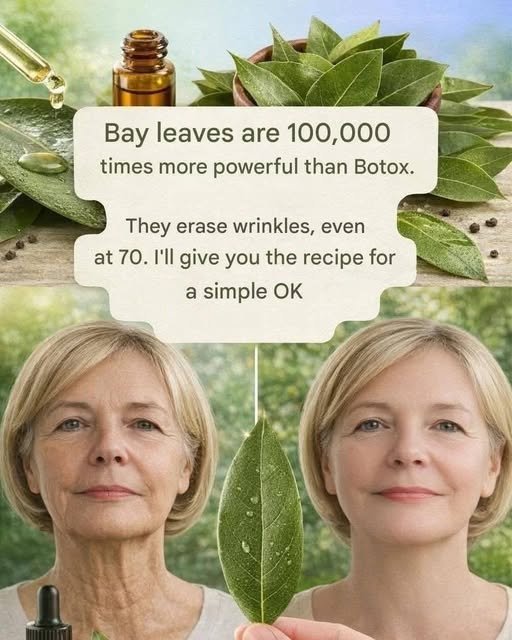
You may have seen an eye-catching claim online that bay leaves are “100,000 times more potent than Botox” and can erase wrinkles naturally.
It sounds incredible—but there is an important problem with this statement: there is no credible clinical evidence showing that bay leaves are 100,000 times more potent than Botox for reducing wrinkles.
That doesn’t mean bay leaves are useless. Bay leaves contain aromatic compounds and antioxidants, and they have a long history of culinary and traditional use. But comparing a kitchen herb directly with an injectable medical treatment isn’t scientifically meaningful.
So, what can bay leaves actually do for your skin?
What Makes Bay Leaves Interesting?
Bay leaves come from plants in the Laurus genus and are widely used to flavor soups, stews, sauces, rice dishes, and other foods.
They contain naturally occurring plant compounds, including aromatic oils and polyphenols. These compounds have attracted scientific interest because of their antioxidant and other biological activities.
But activity observed in a laboratory doesn’t automatically mean that applying bay-leaf water or oil to human skin will produce the same effect.
That’s an important distinction when evaluating natural skincare claims.
Can Bay Leaves Really Work Like Botox?
No evidence currently establishes that bay leaves can reproduce the wrinkle-reducing action of Botox.
Botulinum toxin products work in a very specific way. When appropriately injected into targeted muscles, they block nerve signals that cause those muscles to contract, temporarily reducing muscle activity and the appearance of certain facial lines. The FDA recognizes botulinum toxin products for temporary improvement of several types of facial wrinkles.
A bay-leaf preparation applied to the surface of the skin does not work through this same mechanism.
So claims such as “bay leaves are 100,000 times stronger than Botox” should be treated as viral marketing rather than established medical fact.
Could Bay Leaves Still Be Useful for Skin?
Potentially, but the claims need to remain modest.
Plant compounds with antioxidant properties may help protect against oxidative stress in laboratory or experimental settings. However, that is very different from demonstrating that a homemade bay-leaf preparation can remove established wrinkles.
There is also a major difference between:
Laboratory evidence → a compound shows biological activity under controlled conditions.
and
Clinical evidence → people use a specific preparation at a specific concentration and measurable improvements are demonstrated in well-designed human studies.
For anti-aging skincare, the second type of evidence is much more useful.
A Simple Bay Leaf Facial Rinse
If you’d like to experiment with bay leaves as a gentle homemade skin rinse, keep the recipe simple.
Ingredients
- 3–4 dried bay leaves
- 2 cups water
Instructions
- Add the bay leaves and water to a small saucepan.
- Bring the water to a gentle boil.
- Reduce the heat and simmer for about 5–10 minutes.
- Remove from the heat and allow it to cool completely.
- Strain the liquid carefully.
- Apply a small amount to clean skin with a cotton pad or clean fingertips.
- Rinse with plain water if your skin feels irritated, dry, or uncomfortable.
Do not use the preparation near the eyes.
Always Patch-Test Homemade Skincare
Natural does not automatically mean irritation-free.
Before applying a homemade bay-leaf preparation to your face, test a small amount on an inconspicuous area of skin first.
Stop using it if you develop:
- Burning
- Redness
- Itching
- Swelling
- Rash
- Persistent irritation
Avoid applying homemade preparations to broken, infected, or severely irritated skin.
What Actually Helps With Visible Wrinkles?
If your goal is healthier-looking, younger-looking skin, there are approaches with substantially more established evidence than homemade bay-leaf remedies.
Protect Your Skin From the Sun
Regular exposure to ultraviolet radiation contributes significantly to premature skin aging.
Using broad-spectrum sunscreen and protecting your skin from excessive sun exposure can help reduce cumulative UV damage.
Keep Your Skin Moisturized
Moisturizers can temporarily make fine lines appear less noticeable by improving the skin’s hydration.
This doesn’t erase wrinkles, but well-hydrated skin can look smoother.
Consider Evidence-Based Skincare
Depending on your skin and goals, dermatologists may recommend ingredients or treatments with clinical evidence for improving signs of skin aging.
It’s worth remembering that the FDA distinguishes ordinary cosmetic claims from products intended to affect the structure or function of the skin. Products making drug-like anti-aging claims can be subject to different regulatory requirements.
What About Botox?
Botox is not a skincare herb or topical cream.
It is a purified botulinum toxin product administered by injection. Its cosmetic effect comes from temporarily reducing activity in targeted muscles, which can soften certain dynamic facial lines.
Like any medical procedure, it also has potential risks and should be administered by an appropriately qualified healthcare professional.
That is why comparing a homemade bay-leaf rinse with Botox in terms such as “100,000 times stronger” doesn’t provide a meaningful scientific comparison.
The Bottom Line
Bay leaves are an interesting culinary herb containing a variety of natural plant compounds, but the claim that they are 100,000 times more potent than Botox is not supported by reliable clinical evidence.
You can certainly enjoy bay leaves in cooking, and a simple homemade preparation may appeal to people interested in natural skincare. Just don’t expect it to freeze facial muscles, erase deep wrinkles, or duplicate the effects of injectable botulinum toxin.
Natural skincare can be part of a healthy routine—but “natural” and “more powerful than Botox” are not the same thing.