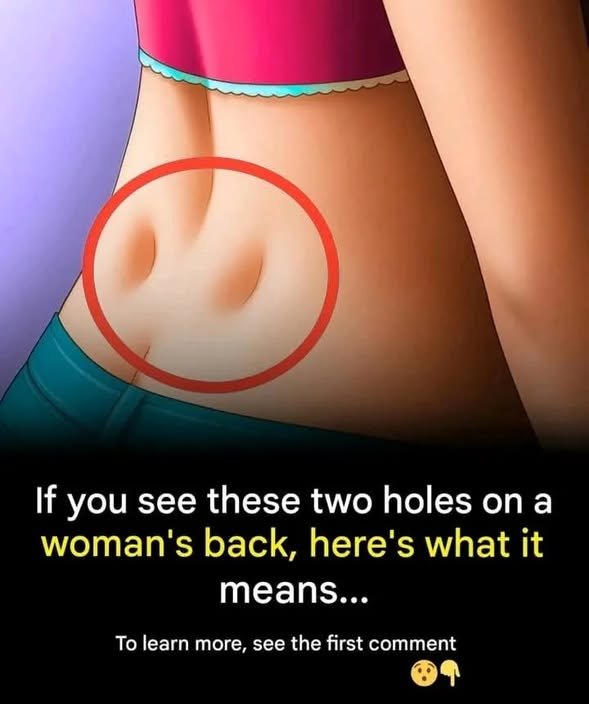
Have you ever noticed two small dimples on either side of your lower back, just above the buttocks?
These little indentations are sometimes called “Venus dimples” in women and “Apollo dimples” in men. They can be quite noticeable in some people and barely visible in others.
Over the years, the internet has attached all kinds of meanings to these dimples. Some claims suggest they reveal something about a person’s personality, attractiveness, fertility, physical strength, or even sexual characteristics.
But the real explanation is much simpler.
Those two dimples are usually a normal anatomical feature caused by the way the skin and underlying connective tissues attach around the pelvis.
What Are the Two Lower-Back Dimples Called?
The dimples are commonly known as Venus dimples when referring to women and Apollo dimples when referring to men.
They are typically located around the area of the posterior superior iliac spines (PSIS)—prominent points on the back of the pelvic bones.
Because these bony landmarks sit relatively close to the skin’s surface, the skin can form small indentations over them.
Why Do Some People Have Them?
The appearance of these dimples is largely determined by anatomy and genetics.
Several factors can influence how visible they are, including:
- Pelvic structure
- Genetics
- Skin and connective-tissue attachments
- Body-fat distribution
- Muscle development
- Overall body composition
Some people naturally have prominent dimples, while others have very subtle ones.
And some people don’t have visible dimples at all.
All of these variations can be completely normal.
Are Lower-Back Dimples a Sign of Good Health?
Not necessarily.
Having these dimples doesn’t prove that someone is particularly healthy or physically fit.
Likewise, not having them doesn’t mean anything is wrong.
A person with very visible dimples can have a wide range of body types and fitness levels, just as someone without visible dimples can be perfectly healthy.
Their visibility is primarily an anatomical characteristic.
Why Do They Become More Visible in Some People?
Changes in body composition can make existing dimples more or less noticeable.
For example, when the layer of fat beneath the skin becomes thinner, the contours of underlying bones and connective tissues may become more visible.
Muscle development can also change the appearance of the lower back and pelvis.
However, exercise doesn’t necessarily create these dimples from scratch. If your anatomy doesn’t naturally produce a visible indentation in that location, doing specific exercises may not produce one.
Can Exercise Make Venus Dimples More Visible?
Exercise can strengthen the muscles surrounding the lower back, hips, and buttocks, potentially making the overall contours of the area more defined.
Exercises such as:
- Squats
- Lunges
- Hip thrusts
- Glute bridges
- Romanian deadlifts
- Back-extension exercises
can develop the surrounding musculature.
But these exercises don’t specifically “create” Venus dimples.
The underlying bone structure and tissue attachments are the major reasons the dimples exist.
Do These Dimples Mean Someone Is More Attractive?
Beauty is subjective, and some cultures or people may consider lower-back dimples attractive.
Their visibility has sometimes been associated with physical fitness or a defined physique in popular culture.
But there is no medical reason to regard them as a measure of attractiveness or physical health.
They’re simply one of the many anatomical variations that make people’s bodies different.
Do They Say Anything About Fertility?
This is another common internet myth.
There is no established medical evidence that having lower-back dimples indicates higher fertility.
The dimples are related to pelvic anatomy and the attachment of tissues around the pelvis. They aren’t a reliable indicator of reproductive health.
Fertility depends on many factors involving reproductive organs, hormones, genetics, age, and overall health.
Do They Indicate Sexual Characteristics?
You may also encounter claims that these dimples indicate sexual performance, sensitivity, or other intimate characteristics.
These claims are not established medical facts.
The presence or visibility of lower-back dimples cannot reliably tell you anything about a person’s sexual function or preferences.
Are They Related to the Spine?
The dimples are located near the lower spine and pelvis, which is why people sometimes assume they represent a problem with the spine.
Usually, they don’t.
The dimples are generally associated with the bony landmarks of the pelvis rather than being a sign that something is wrong with the spinal column.
However, a new indentation accompanied by pain, swelling, redness, weakness, numbness, or another unusual symptom deserves medical attention.
What About Children?
Small dimples or skin indentations can occur in children as well.
Most are harmless anatomical variations.
However, certain unusual skin dimples—particularly those located directly over the midline of the spine rather than symmetrically over the pelvis—can sometimes require medical assessment.
Parents should seek medical advice if a child’s spinal-area dimple is associated with features such as:
- A tuft of hair
- A skin tag
- A birthmark
- A deep or unusual pit
- Drainage
- Swelling
- Changes in leg movement
- Weakness
- Bladder or bowel problems
These features don’t automatically mean there is a serious problem, but they can help a clinician determine whether further evaluation is appropriate.
Can You Get These Dimples by Losing Weight?
Weight loss may make naturally existing dimples more visible because less tissue covers the underlying pelvic contours.
But losing weight does not guarantee that someone will develop them.
Your genetics and skeletal structure play a major role.
It’s also important not to pursue excessive weight loss simply to make these dimples more noticeable. Healthy body composition is more important than achieving a particular physical feature.
Are Venus Dimples Rare?
They’re not necessarily rare, although their visibility varies considerably.
Some people have clearly defined dimples, while others have shallow indentations that are only noticeable under certain lighting or body positions.
Body shape, skin thickness, muscle development, and genetics all influence how easily they can be seen.
The Interesting Truth About These Dimples
Perhaps the most interesting thing about lower-back dimples is that they don’t need a mysterious explanation.
Human bodies naturally have countless small variations.
One person’s pelvic anatomy may create a noticeable indentation, while another person’s anatomy produces a smoother contour.
Neither is inherently better.
When Should a Lower-Back Dimple Be Checked?
A longstanding, symmetrical pair of dimples without symptoms is generally not something to worry about.
However, seek medical advice if you notice a new or changing indentation associated with:
- Persistent pain
- Numbness or tingling
- Weakness
- Swelling
- Redness or warmth
- Drainage
- A lump
- Significant changes in the surrounding skin
These symptoms may have nothing to do with the dimple itself, but they should not simply be dismissed as a normal anatomical feature.
Final Thoughts
The two little dimples above the buttocks are usually a fascinating example of normal human anatomy.
Often called Venus dimples or Apollo dimples, they occur around the bony landmarks of the pelvis and are influenced by genetics, skeletal structure, connective tissue, and body composition.
They don’t reliably reveal personality, fertility, sexual characteristics, or overall health.
So if you have them, they’re simply one of the features that makes your anatomy unique. And if you don’t have them, that’s equally normal.
SEO Title
The Meaning of the Two Dimples in the Lower Back: What They Really Indicate
Meta Description
What do the two dimples above the buttocks mean? Learn why Venus or Apollo dimples appear, what causes them, and which common myths about them aren’t supported by science.