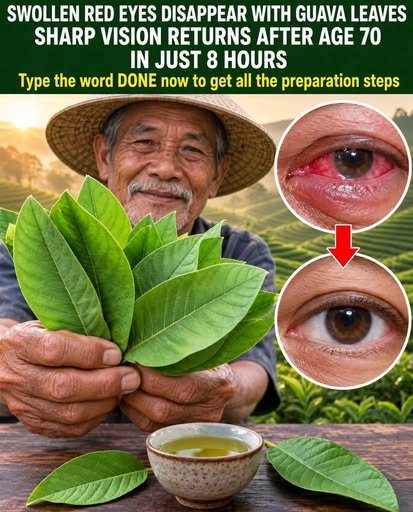
A story claiming that a 71-year-old man stopped using eye drops after 10 years and then used guava leaves to eliminate eye redness, swelling, and even restore extremely sharp vision in just eight hours sounds remarkable. But when it comes to your eyes, remarkable claims deserve careful examination.
Guava leaves have been used traditionally in different forms, and laboratory research has identified potentially useful plant compounds in them. However, there is no good clinical evidence showing that placing guava leaves, guava-leaf water, or homemade guava preparations in the eyes can restore sharp vision within eight hours.
In fact, sudden changes in vision should never be treated as something to experiment with at home.
What Makes Guava Leaves Interesting?
Guava leaves (Psidium guajava) contain various plant compounds, including flavonoids and other phenolic substances. Research has investigated guava leaves for several potential biological effects, but human clinical evidence remains limited for many proposed medical uses.
There has even been older laboratory and animal research investigating a guava-leaf decoction as a possible topical antibacterial preparation for the eye. However, the researchers noted an important problem: sterility was difficult to maintain, with fungal growth appearing in the stored preparation. This is very different from proving that homemade guava-leaf preparations safely treat human eye conditions.
Can Guava Leaves Remove Eye Redness?
There is currently no reliable clinical evidence that guava leaves can eliminate ordinary eye redness.
Red eyes have many possible causes, including:
- Dry eyes
- Allergies
- Dust or other irritants
- Eye strain
- Infections
- Eyelid inflammation
- Injury
- Inflammation inside the eye
- Certain eye diseases
Because the cause matters, simply making the eye look less red does not necessarily mean the underlying problem has been treated.
Some commercial redness-relieving drops temporarily shrink blood vessels on the surface of the eye. But certain decongestant drops can cause rebound redness when overused, which is one reason eye specialists often recommend appropriate lubricating drops for some cases of dry or irritated eyes instead.
What About Eye Swelling?
Eye swelling can also have many causes.
It may occur with allergies, irritation, infection, inflammation, trauma, or other conditions. Guava leaves have not been established as a reliable treatment for these causes.
More importantly, redness combined with swelling and blurred vision should not automatically be treated as a minor problem. The combination can sometimes require prompt evaluation by an eye-care professional.
Can Guava Leaves Restore Extremely Sharp Vision in 8 Hours?
This is the part of the viral claim that should be treated with the most skepticism.
There is no established medical evidence that guava leaves can restore severely reduced vision to exceptionally sharp vision in eight hours.
Vision can temporarily appear clearer when a problem such as dry eye, eye strain, or temporary irritation improves. But that is very different from actually reversing an underlying eye disorder.
Changes in eyesight can be associated with conditions affecting the cornea, lens, retina, optic nerve, or other parts of the visual system. Some require specific medical treatment rather than home remedies.
So the claim that guava leaves can produce dramatically sharper vision within eight hours is not supported by current clinical evidence.
Should You Put Guava Leaves or Guava Water Directly Into Your Eyes?
This is where a viral remedy can become potentially risky.
The surface of the eye is delicate, and homemade preparations are not produced under the sterile conditions required for ophthalmic medicines. Even if a plant has potentially useful compounds, that does not mean a homemade preparation is safe to put into the eye.
Research into herbal medicines has also documented that some herbal products can cause ocular adverse effects, demonstrating why “natural” does not automatically mean “safe for the eyes.”
For this reason, it is better not to place raw guava leaves, crushed leaves, homemade guava juice, or unsterilized guava-leaf water directly into the eyes.
What Can You Do for Mild Eye Irritation?
If your eyes are mildly irritated from dryness or environmental factors, simple measures may help:
Give Your Eyes a Break
If you spend many hours looking at a phone or computer, take regular breaks and consciously blink more often.
Protect Your Eyes From Irritants
Dust, smoke, strong wind, and excessive exposure to dry air can irritate the eyes. Sunglasses can provide useful protection outdoors.
Consider Artificial Tears
For some cases of dry or irritated eyes, preservative-free artificial tears may provide relief. The appropriate product depends on the cause of the symptoms.
Don’t Rub Your Eyes
Rubbing can further irritate the surface of the eye and may worsen inflammation.
Avoid Contact Lenses During Redness
If your eye is red or uncomfortable, particularly while wearing contact lenses, it is important to take the symptom seriously because certain eye infections can become serious.
When Red Eyes Need Medical Attention
Don’t rely on a home remedy if redness is accompanied by:
- Sudden or worsening blurred vision
- Significant eye pain
- Strong sensitivity to light
- Severe swelling
- Pus or unusual discharge
- Flashes or loss of vision
- Halos around lights
- Severe headache with nausea
- An eye injury
- A chemical entering the eye
Some of these symptoms can signal an urgent eye problem. Medical sources specifically advise prompt evaluation when red eyes occur together with pain or vision changes.
The Bottom Line
Guava is a nutritious fruit, and guava leaves contain biologically active plant compounds that scientists continue to study. But that doesn’t mean guava leaves are a proven eye treatment.
The story of a 71-year-old person regaining exceptionally sharp vision after using guava leaves may sound inspiring, but an individual story is not clinical evidence. There is currently no solid evidence that guava leaves can eliminate eye redness and swelling or restore vision within eight hours.
Most importantly, don’t stop prescribed eye treatment simply because of a viral home remedy claim. If eye drops haven’t helped after years of use, the safer approach is to have the diagnosis and treatment plan reassessed by an ophthalmologist.
Your eyes are too important to gamble with an unproven remedy.