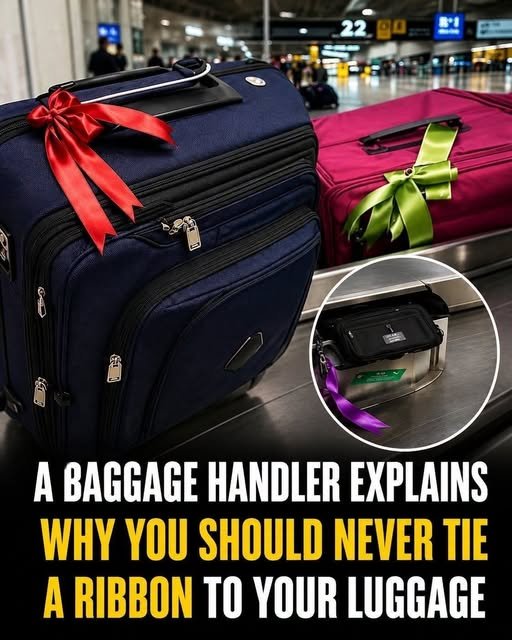
Tying a colorful ribbon to your suitcase might seem like a clever way to identify your luggage at the airport. After all, baggage carousels are crowded, suitcases often look alike, and spotting your belongings quickly can save time and stress. However, some baggage handlers warn that ribbons tied to luggage handles may create unexpected problems during airport baggage processing.
Before attaching a ribbon to your suitcase for your next trip, it is worth understanding the potential risks, what airport workers actually do with checked bags, and which alternatives can help you identify your luggage more easily.
1. Ribbons Can Get Caught in Baggage-Handling Equipment
One of the main concerns with ribbons is that loose fabric can become caught in moving parts of baggage-handling systems. Airports use conveyor belts, rollers, automated sorting machines, and other equipment to move thousands of bags every day.
A long ribbon that hangs from a suitcase handle could potentially snag on equipment or another bag. This may slow the movement of luggage or require an employee to intervene.
Not every ribbon will cause a problem, and a short, securely attached ribbon may pass through the system without incident. Nevertheless, keeping loose accessories away from checked luggage can reduce the chance of snagging.
2. Your Suitcase May Need Extra Handling
Airport baggage systems are designed to process luggage efficiently. When a bag becomes caught, damaged, or difficult to move, staff may need to remove it from the normal flow and handle it separately.
Although a ribbon alone does not automatically cause delays, a loose accessory could contribute to a handling problem under certain circumstances.
For a smoother journey, avoid attaching anything that dangles from your suitcase, especially if you are checking it in for a flight.
3. Ribbons May Not Be as Reliable as You Think
Many travelers use bright ribbons to distinguish their suitcases from similar-looking bags. This can be helpful at baggage claim, but ribbons are not a foolproof identification method.
Other travelers may use the same color, and ribbons can become loose, torn, or detached during transportation. If your ribbon disappears, you may find yourself searching through dozens of nearly identical suitcases.
A more dependable approach is to choose luggage with a distinctive color, pattern, or design and add a clearly identifiable luggage tag.
4. Knotted Ribbons Can Be Difficult to Remove
A ribbon tied tightly around a handle may become tangled with other luggage or accessories. If it catches on something, removing it could require extra effort.
Some ribbons also have small decorative pieces, clips, or metal attachments that may become loose during handling.
If you prefer using a ribbon, choose a short piece that is securely fastened and does not hang freely. However, a purpose-made luggage strap or identification tag is generally a more practical option.
5. Ribbons Can Make Luggage Identification Less Dependable
Baggage handlers process large volumes of suitcases, and identifying information on a bag is important when luggage must be matched to its owner.
A ribbon is mainly a visual marker. It does not establish ownership, provide contact information, or replace the official baggage tag attached at check-in.
For that reason, travelers should use a proper luggage tag with their name and a reliable contact method. For privacy, consider displaying only the information needed to identify and return the bag rather than unnecessary personal details.
6. What Should You Use Instead of a Ribbon?
If you want to identify your suitcase quickly without adding a loose accessory, there are several alternatives.
Choose distinctive luggage: A suitcase with a unique color or pattern is easier to recognize on a crowded carousel.
Use a luggage tag: A durable tag helps identify your bag if it is misplaced. Keep your contact details current.
Add a secure luggage strap: A properly fitted strap can make your suitcase easier to recognize and may help keep it closed. Make sure it is approved for your airline’s baggage requirements and cannot dangle.
Use a luggage tracker: A compatible tracking device can help you locate your belongings, although availability and tracking accuracy depend on the device and surrounding technology.
Take a photograph: Photograph your suitcase before checking it in. A picture showing its color, shape, brand, and distinguishing features can help when reporting missing luggage.
7. What About Airport Security?
A ribbon does not automatically make your luggage suspicious, nor does tying one to a suitcase necessarily cause airport security problems. Security screening procedures vary, and a ribbon is not a substitute for following airline and airport rules.
The more practical concern is whether an accessory can snag, detach, or interfere with baggage handling.
Before traveling, check your airline’s baggage requirements and make sure all straps, tags, and accessories are securely attached.
8. What Do Baggage Handlers Want Travelers to Know?
The most useful lesson is to keep checked luggage simple, secure, and easy to identify. Loose accessories can sometimes create handling issues, while distinctive luggage and reliable identification methods can make collecting or recovering a bag easier.
However, it is important not to treat every warning about ribbons as a universal airport rule. The risk depends on the ribbon’s size, how securely it is attached, and the baggage-handling system involved. Without a specific statement from a named baggage handler or airport, claims about a particular incident or official policy should not be presented as established fact.
Final Thoughts
Tying a ribbon to your suitcase is a common travel habit, and a ribbon will not necessarily cause trouble. Still, loose fabric can potentially snag on baggage-handling equipment, and ribbons may fall off or fail to distinguish your suitcase reliably.
For a more dependable solution, choose distinctive luggage, use a secure identification tag, consider a luggage tracker, and photograph your suitcase before departure. These small precautions can help make your next airport experience less stressful.
Travel tip: Before checking in, make sure your suitcase has its official airline baggage tag, all accessories are secure, and your contact information is up to date.
SEO Title: Why You Should Never Tie a Ribbon on Your Luggage
Focus Keyphrase: why you should never tie a ribbon on your luggage
URL Slug: why-never-tie-ribbon-on-luggage
Meta Description: Discover why loose ribbons on luggage may cause baggage-handling problems and learn safer, more reliable ways to identify your suitcase while traveling.
Tags: Travel Tips, Airport Tips, Luggage Safety, Baggage Handling, Air Travel Advice, Packing Tips