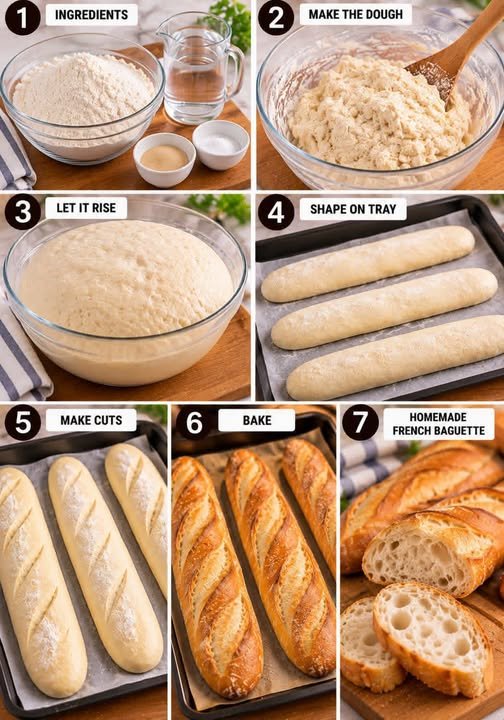
There is nothing quite like the aroma of freshly baked bread filling your kitchen. This Homemade French Baguette has a beautifully crisp, golden crust on the outside and a soft, airy, chewy crumb inside.
Made with just a few simple ingredients—flour, water, yeast, and salt—this classic French bread proves that you don’t need complicated ingredients to make something truly delicious. Serve it warm with butter, use it for sandwiches, or pair it with soups, pasta, and your favorite dips.
Why You’ll Love This Homemade Baguette
- Crisp, golden crust
- Light and airy center
- Made with simple pantry ingredients
- No special bread machine required
- Perfect with soups and stews
- Excellent for sandwiches and bruschetta
- Freezes beautifully
- Freshly baked flavor at home
Ingredients
- 3 1/2 cups (440g) bread flour or all-purpose flour
- 1 1/2 cups (360ml) lukewarm water
- 2 1/4 teaspoons (7g) active dry yeast
- 1 1/2 teaspoons salt
- 1 teaspoon sugar, optional
- Extra flour, for shaping
- Cornmeal or parchment paper, for the baking surface
Instructions
1. Activate the Yeast
Pour the lukewarm water into a large mixing bowl.
Add the yeast and sugar if using.
Stir gently and let the mixture stand for about 5–10 minutes.
The yeast should become slightly foamy on the surface.
If using instant yeast, you can skip this activation step and mix it directly with the flour.
2. Make the Dough
Add the flour and salt to the bowl.
Mix with a wooden spoon or sturdy spatula until a rough, sticky dough forms.
Don’t worry if the dough looks slightly messy at this stage.
A baguette dough should be relatively soft and hydrated.
3. Knead the Dough
Transfer the dough to a lightly floured work surface.
Knead for approximately 8–10 minutes, until the dough becomes smoother and more elastic.
Alternatively, use a stand mixer fitted with a dough hook and knead on low to medium speed for about 6–8 minutes.
The dough should remain slightly tacky but shouldn’t be excessively sticky.
4. First Rise
Place the dough into a lightly oiled bowl.
Cover it with plastic wrap or a clean kitchen towel.
Let it rise in a warm, draft-free place for approximately 1–1 1/2 hours, or until it has roughly doubled in size.
The exact time depends on the temperature of your kitchen.
5. Divide the Dough
Gently turn the risen dough onto a lightly floured surface.
Avoid aggressively punching all the air out.
Divide the dough into 2 or 3 equal portions, depending on the size of baguettes you want.
For longer, thinner baguettes, divide into three portions.
6. Shape the Baguettes
Take one portion of dough and gently flatten it into a rough rectangle.
Fold the top third toward the center and press lightly.
Fold the bottom third upward and seal.
Then fold the dough lengthwise and pinch the seam closed.
Roll the dough gently with your hands until it becomes a long, narrow loaf.
Repeat with the remaining dough.
Aim for baguettes approximately 14–16 inches long, depending on the size of your baking surface.
7. Second Rise
Place the shaped baguettes seam-side down on parchment paper or a lightly floured kitchen towel.
Cover loosely and allow them to rise for approximately 30–45 minutes.
They should look noticeably puffier but don’t necessarily need to double in size.
8. Preheat the Oven
While the baguettes are rising, preheat your oven to 475°F (245°C).
Place a heavy baking tray or empty metal pan on the bottom rack of the oven.
The high temperature is important for developing the characteristic crisp baguette crust.
9. Score the Dough
Once the baguettes have finished their second rise, carefully transfer them to a baking sheet.
Using a very sharp knife, bread lame, or razor blade, make 3–5 diagonal cuts along the top of each baguette.
Make the cuts at a slight angle and avoid pressing down too hard.
Scoring gives the expanding dough room to rise in the oven and creates the classic baguette appearance.
10. Create Steam
Place the baguettes in the preheated oven.
Immediately pour about 1 cup of hot water into the preheated empty metal pan on the lower rack.
Close the oven door quickly.
The steam helps the crust remain flexible during the first part of baking, allowing the baguettes to expand properly and develop a crisp exterior.
Use caution when adding water to a hot pan, as steam can cause burns.
11. Bake
Bake at 475°F (245°C) for about 10 minutes.
Then carefully remove the steam pan if possible and reduce the oven temperature to 425°F (220°C).
Continue baking for another 12–18 minutes, or until the baguettes are deeply golden brown and sound hollow when tapped.
12. Cool Completely
Transfer the baguettes to a wire rack.
Allow them to cool for at least 20–30 minutes before slicing.
Although it’s tempting to cut into them immediately, allowing them to cool helps the crumb finish setting properly.
Tips for the Best French Baguette
Measure Flour Carefully
Too much flour can make the dough dense. Using a kitchen scale is the most reliable way to achieve consistent results.
Don’t Add Too Much Flour
The dough should be slightly sticky. Adding excessive flour during kneading can produce a heavy loaf instead of a light, airy baguette.
Give the Dough Enough Time
Rising time depends on your kitchen temperature. Don’t rely only on the clock. Look for a dough that has expanded noticeably and feels airy.
Don’t Skip Steam
Steam is one of the secrets to a crisp baguette crust. It helps the dough expand during the early stage of baking.
Score With Confidence
Use a sharp blade and make quick, decisive cuts. Hesitating with the blade can deflate the dough.
Bake Until Deeply Golden
A pale baguette usually hasn’t developed its full crust flavor. Allow the bread to become a rich golden brown.
How to Get an Extra-Crispy Crust
For an especially crisp crust:
- Preheat the oven thoroughly.
- Use steam during the first part of baking.
- Avoid opening the oven unnecessarily.
- Bake until deeply golden.
- Allow the baguettes to cool uncovered on a wire rack.
If your oven has a convection setting, you can use it carefully during the final few minutes to help dry and crisp the crust.
How to Store Homemade Baguettes
Fresh baguettes are best eaten the same day.
For short-term storage, wrap the cooled bread loosely in a clean kitchen towel or place it in a paper bag.
Avoid storing baguettes in the refrigerator because refrigeration can make bread stale more quickly.
Freezing
To freeze a baguette, allow it to cool completely.
Wrap it tightly in plastic wrap followed by aluminum foil or place it in a freezer-safe bag.
Freeze for up to 2–3 months.
Thaw at room temperature and reheat in a 350°F (175°C) oven for approximately 8–12 minutes to restore some of the crispness.
Ways to Serve French Baguette
Fresh baguette is incredibly versatile.
Serve slices with:
- Salted butter
- Garlic butter
- Olive oil and herbs
- Soup or stew
- Pasta
- Cheese
- Charcuterie
- Scrambled eggs
- Roasted vegetables
- Bruschetta toppings
You can also turn leftover baguette into homemade croutons, breadcrumbs, garlic bread, or French toast.
Frequently Asked Questions
Can I use all-purpose flour?
Yes. Bread flour generally produces a slightly chewier texture, but all-purpose flour works very well for homemade baguettes.
Why is my baguette dense?
Dense bread can result from adding too much flour, insufficient rising time, inactive yeast, or overworking the dough during shaping.
Why didn’t my baguette get crispy?
The oven may not have been hot enough, or there may not have been enough steam during the beginning of baking. Make sure the oven is fully preheated and use a steam method during the first part of baking.
Can I make the dough the night before?
Yes. For more developed flavor, you can cover the dough and let it rise slowly in the refrigerator overnight. Bring it out the next day, allow it to warm slightly, then shape and bake.
How do I know when the baguette is done?
It should be deeply golden brown and sound hollow when tapped. If you use an instant-read thermometer, the center should generally be around 200–210°F (93–99°C).
Final Thoughts
Making a Homemade French Baguette takes a little patience, but the reward is well worth it. With a handful of simple ingredients and the right technique, you can create bread with a crisp, beautifully browned crust and a light, chewy interior.
Serve it fresh from the oven alongside your favorite soup or pasta, or simply slice it and enjoy it with butter. Once you master the basic method, you’ll have a versatile bread recipe you can return to again and again.
SEO Details
SEO Title: Homemade French Baguette Recipe – Crispy & Chewy
Meta Description: Learn how to make a Homemade French Baguette with a crisp golden crust and soft, airy center using simple ingredients and easy step-by-step instructions.
Focus Keyword: Homemade French Baguette
Secondary Keywords:
French baguette recipe, homemade baguette bread, crispy French bread, easy baguette recipe, authentic-style French baguette, homemade crusty bread, easy French bread recipe
Suggested URL Slug:
homemade-french-baguette
Excerpt:
Learn how to make a classic Homemade French Baguette with a crisp golden crust and light, airy center. This easy bread recipe uses simple ingredients and is perfect for sandwiches, soups, pasta, or serving with butter.