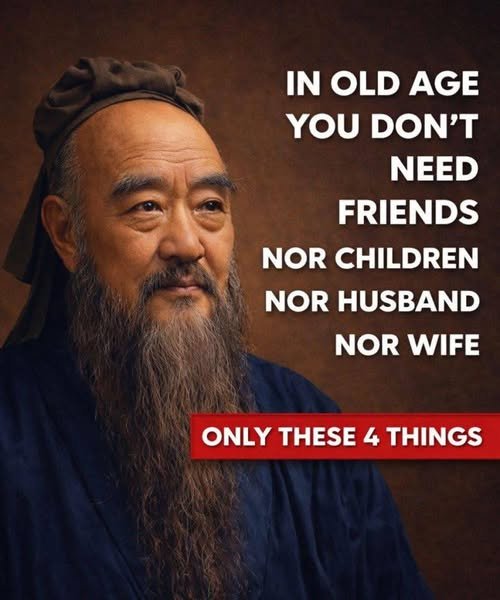
Growing older is often described as something to fear.
People worry about losing their health, independence, social connections, or sense of purpose. But more than 2,500 years ago, Confucian thought offered a different way of looking at the later stages of life: aging can be a continuation of personal growth rather than simply a decline.
One of the best-known passages in the Analects describes Confucius reflecting on his own development through different ages. He writes that at 15 he devoted himself to learning, at 30 he became established, at 40 he was no longer perplexed, at 50 he understood the Mandate of Heaven, at 60 his ear became attuned, and at 70 he could follow his heart’s desires without crossing moral boundaries.
Modern scholars have interpreted this as a picture of aging as a lifelong process of moral and personal cultivation rather than a simple decline.
While the following four principles are a modern interpretation inspired by Confucian ideas, they offer surprisingly practical lessons for anyone who wants to approach later life with greater balance, dignity, and purpose.
1. Keep Learning — Don’t Let Your Mind Retire
One of the strongest themes in Confucian thought is the importance of learning.
Learning isn’t supposed to end when someone retires from a career.
You can stop working and still continue growing.
You can learn a language, read history, study religion or philosophy, learn to cook something new, explore technology, develop a craft, or simply become more curious about the world around you.
The point isn’t to collect certificates.
It’s to keep your mind engaged.
Confucian approaches to healthy aging have specifically highlighted lifelong learning as an important part of aging well.
Why This Matters as You Get Older
Retirement can sometimes remove the structure that previously gave a person’s days meaning.
Learning creates a new reason to wake up curious.
Instead of saying:
“I’ve already learned everything I need to know.”
Try asking:
“What can I still discover?”
That simple change in attitude can make later life feel like another chapter rather than an ending.
Try This
Choose one subject that genuinely interests you.
Spend 20–30 minutes several times a week learning about it.
It doesn’t need to be difficult.
Read a book. Watch an educational program. Learn a recipe. Practice a musical instrument. Talk to someone who knows something you don’t.
A curious mind has no mandatory retirement age.
2. Build Inner Balance Instead of Chasing Other People’s Approval
As people grow older, they may become less interested in impressing everyone around them.
And that can be a strength.
Confucian philosophy places considerable importance on cultivating oneself and developing good character. The goal isn’t simply to appear successful to other people; it’s to become a person whose actions are consistent with their values.
This becomes particularly meaningful in later life.
You may no longer need to prove that you’re the smartest person in the room.
You don’t have to win every argument.
You don’t have to respond to every criticism.
You don’t have to compare your retirement, house, children, possessions, or lifestyle with someone else’s.
A balanced life requires knowing what deserves your attention—and what doesn’t.
Growing Older Can Bring Perspective
At 30, a disagreement may feel enormous.
At 60, you may realize that some arguments simply aren’t worth your energy.
At 70, you may value peace more than being right.
This doesn’t mean becoming passive or allowing people to mistreat you.
It means becoming more selective about where you spend your emotional energy.
Confucius’ description of reaching 70—following one’s heart while remaining within moral boundaries—can be read as an image of maturity in which personal desire and ethical restraint are no longer constantly fighting each other.
Try This
Before reacting to something that upsets you, ask:
“Will this still matter to me a year from now?”
Sometimes the wisest response is action.
Sometimes it is conversation.
And sometimes it is simply letting something go.
3. Protect Your Relationships — But Don’t Lose Yourself
Confucian thought places enormous importance on relationships, responsibility, family, and social harmony. The concept of ren, often translated as humaneness or benevolence, is central to Confucian ethics.
That has an important lesson for older adults:
A fulfilling old age is rarely built entirely alone.
Family, friends, neighbors, community, and meaningful social connections can all contribute to a sense of belonging.
But maintaining relationships doesn’t mean sacrificing your entire identity for other people.
Healthy relationships involve both connection and boundaries.
Don’t Wait Until Old Age to Repair Every Relationship
One of the most painful experiences later in life can be realizing that years disappeared while resentment remained.
Maybe you haven’t spoken to a sibling in years.
Maybe pride prevented an apology.
Maybe an old argument became a permanent wall.
Not every relationship can—or should—be repaired.
But where reconciliation is safe and genuinely possible, it may be worth considering.
A simple phone call can sometimes accomplish more than years of silently replaying an argument.
And Don’t Forget Friendship
Children may become busy.
Grandchildren may grow up.
Partners may have their own interests.
That’s why maintaining friendships and community connections matters.
Have coffee with someone.
Visit relatives.
Join a community group.
Volunteer.
Attend religious or cultural gatherings if they are meaningful to you.
Aging doesn’t have to mean shrinking your world.
4. Live With Purpose, Not Just Routine
Perhaps the deepest lesson is that getting older should not mean giving up on meaning.
A person doesn’t need a huge ambition to have purpose.
Purpose can come from helping family.
Teaching grandchildren.
Mentoring a younger person.
Volunteering.
Growing a garden.
Writing.
Learning.
Serving the community.
Practicing one’s faith.
Caring for a spouse.
Creating something useful.
Or simply becoming wiser and kinder with every passing year.
Confucian interpretations of aging emphasize the idea that later life can represent the culmination of a lifelong process of moral cultivation.
That is a very different picture from the idea that old age is merely a period of decline.
Ask Yourself One Important Question
Instead of asking:
“What can I no longer do?”
occasionally ask:
“What can I still contribute?”
The answer may surprise you.
Experience itself is valuable.
The lessons you’ve learned from mistakes, relationships, work, hardship, success, and failure can become useful to someone younger.
You don’t have to be wealthy or powerful to leave something meaningful behind.
Sometimes wisdom is the legacy.
The Confucian View of Aging Is About Becoming, Not Just Growing Older
One of the most interesting aspects of Confucius’ famous passage about age is that each stage represents a form of development.
You learn.
You establish yourself.
You become less confused.
You gain perspective.
You become more receptive.
And eventually, ideally, your desires and your principles become more harmonious.
In other words:
The goal isn’t simply to live longer.
The goal is to become wiser while you live.
That distinction can completely change the way we think about aging.
5 Simple Ways to Put These Ideas Into Practice
You don’t need to become a philosopher to benefit from these principles.
Start small.
Read Something New
Give your mind something interesting to explore every week.
Protect Your Peace
Not every disagreement deserves your energy.
Maintain Meaningful Relationships
Call the people you genuinely care about instead of waiting for them to call first.
Do Something Useful
Help someone, teach someone, create something, or contribute to your community.
Reflect on Your Life
Don’t only count your years.
Ask what those years have taught you.
What Confucius Can Teach Us About Modern Retirement
Modern retirement can sometimes create an unexpected problem.
A person works for decades toward the day when they finally have “nothing to do.”
Then that day arrives.
And suddenly, having nothing to do isn’t as enjoyable as expected.
This is why retirement may be better understood as a transition rather than an ending.
You lose one role and gain the opportunity to develop another.
You may no longer be an employee.
But you can become a mentor.
A grandparent.
A volunteer.
A student.
A traveler.
An artist.
A gardener.
A community member.
A teacher.
Or simply a person with more freedom to pursue meaningful interests.
Your identity doesn’t have to disappear when your job does.
The Most Important Lesson: Don’t Fear Becoming Older
Aging is unavoidable.
But the meaning we attach to aging is not.
You can approach later life with fear, resentment, and constant comparison.
Or you can approach it as another opportunity for learning, relationships, reflection, and contribution.
Confucius’ famous description of his own life suggests that maturity isn’t achieved all at once. It develops gradually through decades of learning and self-cultivation.
So don’t measure a successful old age only by money, physical appearance, or the number of years you’ve lived.
Measure it by something deeper:
Are you still learning?
Are your relationships meaningful?
Can you live with yourself peacefully?
Do your actions reflect your values?
Do you still have something meaningful to give?
If the answer is yes, then growing older doesn’t have to mean becoming less.
It can mean becoming more fully yourself.
Final Thoughts
The four principles inspired by Confucian thought can be summarized simply:
Keep learning.
Cultivate inner balance.
Nurture meaningful relationships.
Live with purpose.
These aren’t guarantees of perfect health, happiness, or longevity. They’re principles for approaching the later chapters of life with greater awareness and dignity.
And perhaps that’s the most beautiful way to think about aging:
You aren’t simply counting down the years. You’re continuing the work of becoming who you are.
SEO Details
SEO Title: 4 Confucian Principles for a Fuller and More Balanced Old Age
Meta Description: Discover four timeless principles inspired by Confucian thought that can help make later life more meaningful, balanced, purposeful, and fulfilling.
Focus Keyword: Confucian principles for old age
Slug: 4-confucian-principles-for-balanced-old-age
Category: Healthy Aging & Lifestyle
Tags: Confucius, Confucian philosophy, healthy aging, aging gracefully, wisdom, retirement, life purpose, personal growth, relationships, meaningful aging