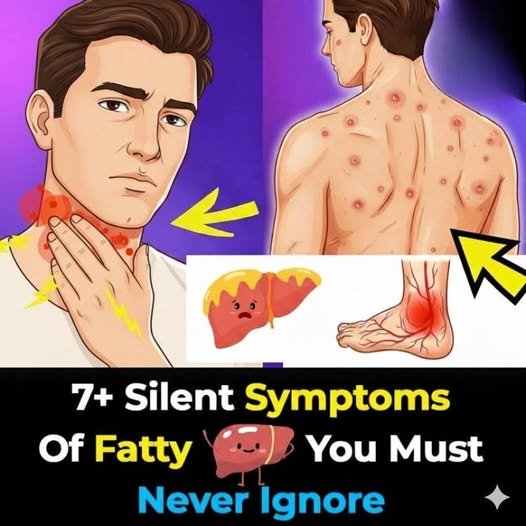
7 “Silent” Symptoms of Fatty Liver: What’s Real and What’s Overhyped
Fatty liver disease is often called a “silent” condition because many people have no noticeable symptoms, especially in its earlier stages. In fact, someone can have significant liver disease without feeling sick.
That makes it easy for misleading lists of “hidden symptoms” to spread online.
So what should you actually watch for?
Here are seven symptoms and signs commonly associated with fatty liver disease—and what they really mean.
1. Unexplained Fatigue
What’s real: Fatigue can occur in people with fatty liver disease.
However, feeling tired is extremely common and has many possible causes, including poor sleep, stress, anemia, thyroid problems, infections, medications, and other medical conditions.
Fatigue by itself does not mean you have fatty liver.
NIDDK identifies tiredness as one of the symptoms that some people with fatty liver disease may experience.
Bottom line: Possible, but not a specific warning sign.
2. Discomfort in the Upper Right Abdomen
The liver is located in the upper-right portion of the abdomen.
Some people with fatty liver disease may experience mild discomfort or a feeling of fullness in this area. However, abdominal discomfort has many other possible causes, including gallbladder, stomach, intestinal, and muscular problems.
Bottom line: It can occur, but it isn’t enough to diagnose fatty liver.
3. Feeling Generally Unwell
Some people report feeling unwell, sluggish, or lacking energy.
The problem is that these symptoms are extremely nonspecific. They can occur with countless conditions—or simply after inadequate sleep or a stressful period.
Fatty liver disease frequently produces no symptoms at all, so feeling normal does not rule it out either.
Bottom line: Possible, but too vague to use as a reliable screening symptom.
4. Enlarged Liver
An enlarged liver can occur with fatty liver disease.
However, you generally cannot determine whether your liver is enlarged simply by feeling your abdomen. A healthcare professional may detect enlargement during an examination, while imaging can provide more information.
NIDDK lists an enlarged liver among physical findings doctors may look for when evaluating fatty liver disease.
Bottom line: A legitimate medical finding, but not something you should try to diagnose yourself.
5. Dark Patches of Skin
This one is often presented online as a direct “sign of fatty liver,” but that is misleading.
Dark, velvety skin—particularly around the neck, armpits, or other skin folds—is more closely associated with insulin resistance, which is an important metabolic risk factor for MASLD.
It doesn’t prove that a person has fatty liver disease.
NIDDK notes that doctors may look for signs of insulin resistance, including darkened skin patches, when evaluating someone for NAFLD/MASLD.
Bottom line: Related to an important risk factor, but not a diagnostic sign of fatty liver.
6. Itching
Itchy skin is frequently included in online lists of “fatty liver symptoms.”
The reality is more complicated.
Mild itching is not one of the classic symptoms that specifically identifies uncomplicated fatty liver. Significant itching can occur with various liver and bile-flow disorders, particularly more advanced disease.
For example, itching is listed among symptoms of cirrhosis, but that does not mean ordinary itching indicates fatty liver.
Bottom line: Don’t assume unexplained itching means you have fatty liver.
7. Jaundice, Swelling, or Easy Bruising
These symptoms deserve particular attention because they can indicate more advanced liver disease, rather than simply early fatty liver.
Possible warning signs include:
- Yellowing of the eyes or skin
- Swelling of the abdomen
- Swelling of the legs or ankles
- Easy bruising or bleeding
- Confusion or changes in thinking
- Significant muscle loss
- Dark urine
These symptoms can occur with advanced liver damage and should not be ignored.
Bottom line: These aren’t typical “early fatty liver symptoms.” They can be warning signs of significant liver disease and warrant medical evaluation.
The Biggest Myth: You Can Always Feel Fatty Liver
One of the most important facts to understand is that fatty liver often causes no symptoms.
Someone can have fatty liver while feeling completely healthy.
That’s why relying on symptoms alone isn’t a good way to determine whether you have it. Doctors may use medical history, physical examination, blood tests, and imaging to investigate suspected fatty liver disease.
Who Is More Likely to Develop Fatty Liver?
The risk is higher in people with certain metabolic conditions, including:
- Overweight or obesity
- Type 2 diabetes or insulin resistance
- High triglycerides
- Abnormal cholesterol levels
- High blood pressure
- Metabolic syndrome
- A larger waist circumference
However, fatty liver can also occur in people who are not overweight, so body weight alone doesn’t completely rule it out.
How Is Fatty Liver Actually Detected?
Symptoms aren’t enough.
Depending on the situation, a doctor may order blood tests and imaging such as an ultrasound. Additional noninvasive tests can help assess whether there is a risk of liver fibrosis, or scarring.
AASLD notes that tools such as FIB-4 can help identify people who may have a higher likelihood of advanced fibrosis.
Importantly, liver enzymes can sometimes be normal even when MASLD is present, so a normal blood test does not necessarily rule it out.
When Should You See a Doctor?
Talk with a healthcare professional if you have persistent fatigue, recurrent upper-right abdominal discomfort, abnormal liver tests, or several metabolic risk factors.
Seek prompt medical attention if you develop symptoms such as yellow skin or eyes, significant abdominal swelling, confusion, vomiting blood, black stools, or unusual bleeding.
The Bottom Line
Fatty liver is often silent, and that’s exactly why internet symptom lists can be misleading.
Fatigue and mild upper-right abdominal discomfort are genuine possible symptoms, while findings such as dark skin patches are better understood as signs associated with insulin resistance rather than proof of fatty liver.
The most reliable way to determine whether fatty liver is present is through appropriate medical evaluation—not by checking off a list of vague symptoms.
If you are concerned about fatty liver, discussing your risk factors and appropriate blood tests or imaging with a healthcare professional is far more useful than trying to diagnose yourself from symptoms.