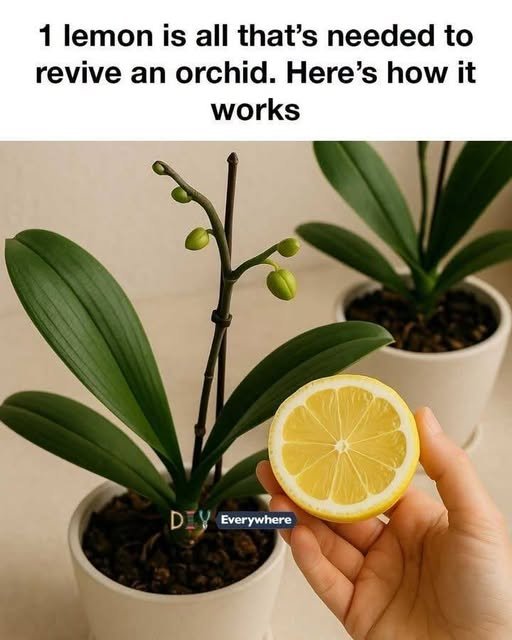
A struggling orchid can be frustrating. Its leaves may look limp, its roots may appear dry or brown, and flowers may have disappeared completely. That’s why simple home remedies—especially the idea that one lemon can bring a dying orchid back to life—are so appealing.
But can lemon really revive an orchid?
The short answer is not by itself.
Lemon juice is acidic and contains citric acid, and some orchid growers discuss carefully adjusting the pH of water. However, that is very different from using lemon juice as a universal plant-revival treatment. The American Orchid Society discusses pH and lemon juice in the context of adjusting water chemistry, not as a miracle cure for unhealthy orchids.
If an orchid is struggling, the most important thing is to identify why it is struggling. In many cases, correcting watering, improving light, removing rotten roots, or replacing degraded potting media can make a much bigger difference than adding lemon.
Why Do People Use Lemon for Orchids?
Lemons contain citric acid, which can lower the pH of water.
This is important because nutrient availability is affected by pH, and orchid growing media and water chemistry can influence how effectively plants access nutrients. The American Orchid Society notes that certain nutrients are absorbed only within particular pH ranges.
However, this doesn’t mean that adding lemon juice automatically makes an orchid healthier.
The amount of lemon juice needed to change water chemistry depends on the starting water quality, its mineral content, and other factors. Fresh lemon juice also varies naturally in acidity.
So the idea that “one lemon is all you need” is far too broad.
Should You Pour Lemon Juice Directly on an Orchid?
It’s better not to treat concentrated lemon juice as an orchid medicine.
An orchid’s roots are sensitive to their growing environment, and unnecessarily changing the chemistry around them can create additional problems.
If an orchid is already stressed, the safest approach is to determine the cause of the problem rather than experimenting with concentrated acidic ingredients.
For routine watering, clean water appropriate for the plant is generally the better choice.
What Actually Revives a Struggling Orchid?
1. Check the Roots First
The roots can tell you a great deal about the condition of an orchid.
Healthy orchid roots are generally firm and substantial. Brown, mushy, hollow, or badly decayed roots can indicate root problems.
Root rot is commonly associated with excessive moisture and poor drainage.
If the orchid has severe root damage, simply adding lemon juice won’t solve the underlying problem.
2. Remove Rotten Roots
If root rot is present, carefully remove the orchid from its container.
Remove the old growing medium and inspect the roots.
Using clean, sterilized scissors, cut away roots that are soft, dead, brown, black, or hollow.
University of Iowa Extension recommends removing dead or decaying roots during repotting and placing the orchid into fresh, coarse growing media.
3. Use the Right Potting Medium
Most commonly grown orchids are not ordinary soil plants.
Many indoor orchids, including Phalaenopsis, are grown in coarse orchid bark or similar well-draining media that allows air to reach the roots.
Old potting material can break down and retain too much moisture. This increases the risk of root problems.
If the bark has become compacted, decomposed, or permanently wet, repotting may be much more helpful than any homemade liquid treatment.
4. Don’t Overwater
One of the biggest mistakes orchid owners make is watering too frequently.
Orchid roots need both moisture and air. Keeping the roots constantly wet can encourage root rot.
Instead of watering according to a rigid calendar, check the condition of the potting medium and the roots.
The American Orchid Society specifically identifies improper watering as one of the major causes of orchid problems.
5. Give It the Right Light
Light is essential for an orchid’s ability to maintain healthy leaves and produce flowers.
For many indoor orchids, bright indirect light is appropriate.
A very dark location can limit growth and flowering, while harsh direct sunlight can damage the foliage.
Iowa State University Extension recommends bright indirect light for many orchids grown indoors.
A good location is often near a bright window where the plant receives plenty of light without sitting in intense, scorching midday sun.
6. Improve Air Circulation
Good air movement is another important part of orchid care.
Stagnant, humid conditions can encourage fungal and bacterial problems, particularly when leaves remain wet.
The American Orchid Society recommends maintaining air movement around orchids to help reduce disease problems.
A gentle fan nearby can help, but avoid blasting the plant with strong air continuously.
What About Using Lemon Water?
If you have heard about watering orchids with diluted lemon water, understand that this is different from claiming that lemon revives dying orchids.
The potential role of lemon is primarily related to acidity and water chemistry.
If your water is already appropriate for orchids, there may be no reason to add lemon at all.
The American Orchid Society explains that water quality, dissolved minerals, fertilizer salts, and pH can all influence orchid health.
For this reason, randomly adding lemon juice without knowing your water chemistry isn’t necessarily beneficial.
A Safer Orchid Recovery Routine
Instead of relying on a lemon remedy, try this simple recovery routine:
Step 1: Inspect
Look at the leaves, roots, potting medium, and growing container.
Step 2: Check Moisture
If the medium is still wet and the roots appear unhealthy, don’t add more water.
Step 3: Check the Roots
If there are mushy or dead roots, remove them carefully.
Step 4: Repot if Necessary
Use fresh, well-draining orchid media if the existing medium has broken down.
Step 5: Improve Light
Move the plant to a bright location with suitable indirect light.
Step 6: Establish Better Watering
Water thoroughly when appropriate, then allow excess water to drain completely.
Never leave the orchid sitting in stagnant water.
Step 7: Feed Carefully
Once the orchid is actively growing and recovering, use a fertilizer formulated for orchids at an appropriate diluted strength.
Orchids generally need relatively small amounts of fertilizer, and excessive fertilizer can damage roots.
Signs Your Orchid May Be Recovering
Recovery doesn’t necessarily mean flowers appear immediately.
Look for gradual improvements such as:
- Firmer leaves
- New root growth
- New green root tips
- New leaves
- Healthy new growth
- Improved overall firmness
- Eventually, a new flower spike
Don’t become discouraged if an orchid doesn’t bloom immediately after being rescued.
The plant may need to rebuild its root system and foliage before it has enough energy to flower.
What If the Orchid Has Wrinkled Leaves?
Wrinkled, leathery, or limp leaves can be associated with insufficient water, but watering more isn’t always the answer.
Root damage can prevent an orchid from absorbing water effectively even when the potting medium is moist.
Iowa State Extension notes that wrinkled leaves can indicate insufficient water, while brown or damaged roots may indicate root problems.
That’s why checking the roots is so important.
What If the Leaves Are Yellow?
A yellowing leaf doesn’t automatically mean the orchid is dying.
Older leaves can naturally age and turn yellow.
However, widespread yellowing can also be associated with environmental stress, watering problems, root damage, or other growing conditions.
Look at the whole plant rather than diagnosing it from one yellow leaf.
Can Lemon Help an Orchid Bloom?
There is no good reason to treat lemon juice as a guaranteed flowering stimulant.
Flowering depends on the orchid species and its growing conditions, including appropriate light, temperature, watering, nutrition, and seasonal cues.
The American Orchid Society describes orchid care as a balance of water, fertilizer, light, temperature, air movement, and humidity.
So if your goal is more flowers, focus on those fundamentals rather than searching for a single kitchen ingredient.
A Simple Homemade Orchid-Care Mistake to Avoid
One of the biggest problems with viral plant hacks is that a remedy that works for one person’s particular water or growing conditions can be presented as a universal solution.
Orchids aren’t all identical.
Different species have different requirements, and even the same species can behave differently depending on light, temperature, humidity, water quality, and potting medium.
A struggling orchid needs diagnosis—not necessarily another ingredient.
Final Thoughts
The idea that one lemon can revive an orchid makes a catchy gardening headline, but lemon juice isn’t a magic cure for a weak, wilted, or dying orchid.
Lemon contains citric acid and may have a role in carefully managing water chemistry, but that is very different from proving that lemon juice can restore an unhealthy orchid.
If your orchid is struggling, start with the basics: inspect the roots, avoid overwatering, use a well-draining orchid medium, provide appropriate light, maintain good airflow, and fertilize carefully when the plant is actively growing.
Those fundamentals give an orchid a much better chance of recovering than relying on a one-ingredient miracle remedy.
And if your orchid is still alive but has lost its flowers, don’t give up on it. With proper care, many orchids can recover, grow new roots and leaves, and eventually flower again.
SEO Details
SEO Title: Can Lemon Revive an Orchid? What Really Works for a Struggling Orchid
Meta Description: Can one lemon really revive an orchid? Learn what lemon juice can and cannot do, plus the proven orchid-care steps that support healthier roots, leaves, and blooms.
Focus Keyphrase: lemon to revive an orchid
Suggested Slug: lemon-revive-orchid