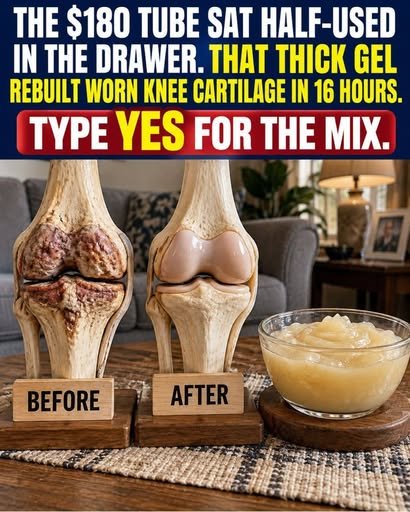
Knee pain can become increasingly frustrating with age. A simple activity such as climbing stairs, standing from a chair, walking downhill, or getting up after sitting for a while can become uncomfortable when the knee is affected by osteoarthritis.
That is why claims about a “thick gel” that rebuilds the knee’s cushion in just 16 hours can sound incredibly appealing—especially when they promise results better than an expensive commercial product.
But there is an important distinction between temporarily relieving knee pain and actually rebuilding damaged cartilage.
There is currently no good evidence that a cream, homemade gel, or topical treatment can rebuild a thicker layer of knee cartilage within 16 hours. Osteoarthritis involves changes to cartilage, bone, the joint lining, ligaments, and other tissues, and cartilage restoration remains an active area of medical research. The National Institute of Arthritis and Musculoskeletal and Skin Diseases notes that current medicinal treatments for knee osteoarthritis do not modify the underlying disease course.
So what might a thick gel actually do?
Why Knee Pain Becomes More Common With Age
Osteoarthritis is more common as people get older. It can cause pain, stiffness, swelling, reduced movement, grinding or scraping sensations, and sometimes a feeling that the knee is unstable or may buckle.
The problem is more complicated than simply having a “thin cushion.”
The knee contains cartilage that covers the ends of bones, along with the meniscus, ligaments, tendons, joint lining, and bone. Changes in these tissues can contribute to pain and reduced function.
That means rubbing something onto the outside of the knee cannot simply replace lost cartilage inside the joint.
Can a Gel Rebuild Knee Cartilage Overnight?
This is where viral health claims often go too far.
A topical gel may make the skin feel cool or warm, provide temporary soothing, or contain an ingredient designed to reduce the sensation of pain. But pain relief is not the same thing as cartilage regeneration.
Even medical researchers are still working on reliable ways to preserve or restore damaged knee cartilage. NIAMS describes cartilage-restoration approaches such as biologic therapies, scaffolds, and cell-based treatments as areas of ongoing research, with important questions about effectiveness, standardization, safety, and long-term results still unresolved.
Therefore, a claim that an ordinary gel can create a denser knee cushion in 16 hours should be treated with considerable skepticism.
What About Hyaluronic Acid?
Hyaluronic acid is sometimes mentioned in advertisements for joint products because it is naturally present in joints and contributes to lubrication.
However, there is an important difference between a topical cream containing an ingredient associated with joints and a medical treatment delivered directly into the knee.
Hyaluronic acid injections, sometimes called viscosupplementation, are injected into the knee joint and are sometimes used for knee osteoarthritis. They are completely different from simply rubbing a gel onto the skin.
Even injections should not be described as a guaranteed way to rebuild cartilage overnight.
What Can Actually Help an Aging Knee?
Fortunately, there are evidence-based approaches that can make a meaningful difference.
1. Regular Exercise
Exercise may sound surprising when your knees hurt, but appropriate physical activity is an important part of osteoarthritis management.
Strengthening the muscles around the knee can help support the joint and improve function. Low-impact activities such as walking, cycling, swimming, or water exercise may be easier for some people.
The appropriate exercise program depends on the person’s pain, mobility, fitness level, and other health conditions.
2. Strengthening the Muscles Around the Knee
Strong quadriceps, hamstrings, hips, and gluteal muscles can help improve lower-body function.
A physical therapist can teach exercises that are appropriate for someone with knee arthritis, particularly when pain or weakness makes ordinary exercise difficult.
3. Weight Management When Appropriate
For people who are overweight or obese, weight reduction can reduce stress placed on the knees.
NIAMS-supported research has found that diet and exercise interventions producing weight loss can reduce knee pain in older adults with knee osteoarthritis.
This does not mean someone needs to lose a large amount of weight before becoming active. Even gradual improvements in activity and nutrition can be useful.
4. Topical Pain-Relief Treatments
Some topical medications can help relieve osteoarthritis-related pain.
For example, topical nonsteroidal anti-inflammatory drugs (NSAIDs) are among the treatments used for knee osteoarthritis. The American College of Rheumatology’s updated 2026 guidance continues to emphasize individualized treatment based on a person’s symptoms, health conditions, lifestyle, and goals.
Older adults should discuss medication choices with a healthcare professional because topical and oral medicines have different benefits, risks, and interactions.
5. Heat or Cold
Heat may help some people with stiffness, while cold can temporarily reduce pain and inflammation after activity.
The best choice depends on the symptoms and the individual.
A Simple At-Home Knee Comfort Routine
If your knee is aching, a gentle routine may be more realistic than searching for a miracle gel.
Morning
Begin with gentle range-of-motion movements rather than immediately putting heavy stress on a stiff knee.
During the Day
Try short periods of low-impact movement instead of remaining seated for hours.
If walking is comfortable, gradually increase activity according to your ability.
After Activity
If the knee feels irritated, a cold pack wrapped in a cloth for a short period may provide temporary comfort.
Never place ice directly against the skin.
Evening
Gentle stretching and appropriate strengthening exercises can become part of a consistent routine.
If pain is persistent, severe, or progressively worsening, professional evaluation is more appropriate than repeatedly trying new home remedies.
What About Homemade Gels?
Many homemade knee remedies circulate online using ingredients such as aloe vera, essential oils, herbs, coconut oil, petroleum jelly, or other household ingredients.
Some may moisturize the skin or provide a pleasant warming or cooling sensation.
But there is no reason to assume that a homemade topical mixture can penetrate the knee and rebuild damaged cartilage.
The knee joint lies beneath several layers of tissue, and cartilage regeneration is a complex biological process.
A thick consistency does not mean a treatment is reaching the cartilage.
Don’t Confuse Temporary Relief With Healing
This is one of the most important points.
Suppose someone applies a gel and their knee feels better several hours later.
That improvement can be real—but it does not prove that cartilage has regenerated.
Pain can change because of multiple factors, including inflammation, muscle tension, activity level, temperature, expectations, and the natural fluctuation of osteoarthritis symptoms.
A product can potentially make someone feel better without repairing the underlying joint damage.
When Knee Pain Needs Medical Attention
Not every painful knee is simply osteoarthritis.
Seek medical assessment if knee pain:
- Appears suddenly after an injury
- Causes significant swelling
- Makes it difficult to put weight on the leg
- Causes repeated buckling or instability
- Is accompanied by redness and significant warmth
- Occurs with fever
- Continues to worsen despite conservative care
- Prevents normal daily activities
- Is associated with severe nighttime pain or unexplained symptoms
A swollen, hot joint accompanied by fever can require urgent evaluation because infection and other conditions need to be ruled out.
The Bottom Line
A “thick gel that rebuilds a denser knee cushion in 16 hours” makes an attention-grabbing headline, but it is not supported by current evidence.
There is no established topical gel that can regenerate a damaged knee’s cartilage overnight.
Knee osteoarthritis is a complex disease involving several joint tissues, and genuine cartilage restoration remains an active area of research.
For older adults dealing with knee pain, the more reliable strategy is to identify the cause and use an appropriate combination of exercise, strengthening, weight management when appropriate, pain-relief treatments, and professional care.
A cream may sometimes help with symptoms, but a temporary reduction in pain should not be confused with rebuilding cartilage.
SEO Title: Knee Pain After 60: Can a Gel Really Rebuild Cartilage in 16 Hours?
Meta Description: Can a thick gel really rebuild knee cartilage in 16 hours? Learn what causes knee pain after 60, what topical gels can do, and which treatments have better evidence.