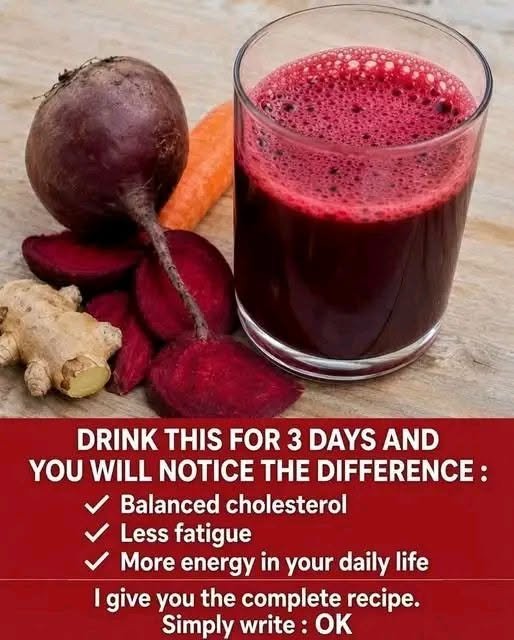
Take this for three days and you’ll notice the difference. That is the kind of claim often made about homemade beetroot, carrot, and ginger drinks. Some versions promise dramatically lower cholesterol, completely pain-free joints, and an instant end to fatigue.
But the reality is more interesting—and more useful.
Beetroot, carrots, and ginger are all nutritious foods containing different naturally occurring compounds. Beetroot provides dietary nitrates, carrots are rich in carotenoids, and ginger contains bioactive compounds such as gingerols. Research has investigated these ingredients for cardiovascular, metabolic, and inflammatory outcomes, but no three-day drink has been shown to eliminate cholesterol, cure arthritis, or permanently remove fatigue.
That doesn’t mean the drink has no place in a healthy diet. It can be a flavorful way to consume vegetables and ginger while increasing your intake of plant compounds and fluids.
Let’s look at what this colorful combination can realistically offer.
What Makes Beetroot, Carrot and Ginger Interesting?
Each ingredient brings something different to the glass.
Beetroot
Beetroot is particularly interesting because it contains naturally occurring nitrates. The body can convert dietary nitrate into nitric oxide-related compounds that participate in blood-vessel function.
Research on beetroot juice has investigated blood pressure and exercise performance. A 2026 evidence-based review found beetroot juice among the plant-based approaches with relatively consistent blood-pressure effects, although results depend on the population, dose, and circumstances.
More recent research has also examined beetroot juice in relation to physical performance and fatigue, with some potential benefits in specific exercise measures, but the evidence is not strong enough to describe beetroot juice as a universal treatment for fatigue.
Carrots
Carrots are an excellent source of carotenoids, particularly beta-carotene, which the body can convert into vitamin A.
Vitamin A is important for normal vision, immune function, and maintaining healthy tissues.
Carrots also provide fiber when consumed whole or blended rather than completely strained.
Ginger
Ginger has been studied for several health purposes, including nausea, digestive symptoms, and certain types of pain.
According to the National Center for Complementary and Integrative Health, research suggests ginger supplements might help reduce symptoms of knee osteoarthritis, although much of the available research has limitations and the evidence isn’t strong enough to call ginger a cure.
Ginger has also been investigated for metabolic health. Recent research has reported modest effects on some measures such as blood sugar, blood pressure, and triglycerides in certain groups, but these findings should not be interpreted as meaning that ginger can replace prescribed treatment.
A Simple Beetroot, Carrot and Ginger Drink
If you’d like to enjoy these ingredients as part of a balanced diet, here’s a simple version.
Ingredients
- 1 small beetroot, peeled and chopped
- 2 medium carrots, washed and chopped
- 1/2-inch piece fresh ginger, peeled
- 1 cup cold water
- 1 tablespoon fresh lemon juice, optional
- A few ice cubes, optional
Directions
- Wash and prepare the beetroot, carrots, and ginger.
- Chop everything into small pieces.
- Add the ingredients to a high-speed blender.
- Pour in the water.
- Blend until smooth.
- Add lemon juice if desired.
- Serve immediately over ice.
For more fiber, do not strain the drink. If you prefer a thinner juice, you can strain it, but remember that some of the fiber will be removed.
Can This Drink Lower Cholesterol?
This is where it’s important to separate a nutritious drink from a medical treatment.
There is no evidence that drinking beetroot, carrot, and ginger juice for three days can reduce cholesterol to zero.
Cholesterol is influenced by genetics, overall dietary pattern, body weight, physical activity, medications, age, and other health conditions.
Ginger research has shown potentially favorable effects on certain metabolic markers, but studies generally involve supplementation over longer periods and don’t prove that a homemade drink produces the same effects.
If you have high LDL cholesterol, the most important step is knowing your actual lipid numbers and discussing them with a healthcare professional.
A healthy eating pattern emphasizing vegetables, fruits, legumes, whole grains, nuts, seeds, and appropriate sources of unsaturated fats is much more meaningful than relying on a single drink.
Can It Cure Arthritis?
No.
Arthritis is not one single disease, and its causes vary. Osteoarthritis, rheumatoid arthritis, gout, and other joint conditions require different approaches.
Ginger has been studied for osteoarthritis symptoms, but NCCIH notes that it remains unclear whether ginger supplementation provides meaningful benefit for osteoarthritis, rheumatoid arthritis, or general joint and muscle pain.
So this drink may be part of a nutritious eating pattern, but it shouldn’t be described as an arthritis cure.
If you have persistent joint swelling, warmth, significant stiffness, or worsening pain, identifying the underlying condition is much more important than searching for a three-day drink.
What About Fatigue?
Feeling tired can have many causes.
Occasional tiredness may be related to:
- Poor sleep
- Stress
- Dehydration
- Not eating enough
- Long periods of inactivity
- Heavy physical activity
- Excessive caffeine use
- Alcohol
- A demanding schedule
But persistent fatigue can also occur with conditions such as anemia, thyroid disorders, sleep apnea, infections, depression, diabetes, medication effects, and other medical problems.
A beetroot-carrot-ginger drink can provide fluids and nutrients, but it doesn’t address all possible causes of fatigue.
Beetroot has been studied for exercise performance and fatigue-related outcomes, but the evidence is specific to particular situations rather than proof that beetroot eliminates everyday fatigue.
What You Might Notice After Three Days
If you drink this for three days, you may simply enjoy having more vegetables and fluids in your diet.
Depending on what you were eating previously, you might notice:
- A refreshing increase in fluid intake
- More vegetable intake
- A different bowel pattern if you retain the fiber
- A pleasant ginger flavor that may support digestion
- A convenient addition to breakfast or a snack
But don’t expect laboratory cholesterol levels, arthritis, or unexplained chronic fatigue to disappear within three days.
Health improvements generally depend on the overall pattern of your diet and lifestyle rather than one drink.
Beetroot Can Temporarily Change Urine and Stool Color
Don’t be alarmed if your urine or stool becomes pinkish or reddish after eating beetroot.
This is commonly called beeturia and can occur because of beet pigments.
It isn’t automatically a sign that something is wrong.
However, if you notice unexplained blood in your urine or stool when you haven’t recently consumed beetroot, seek medical advice rather than assuming it is from food.
Important Considerations Before Drinking It Regularly
This is a food-based drink, but that doesn’t mean everyone should consume unlimited amounts.
Blood pressure
Because beetroot and ginger have been studied for blood-pressure effects, people who already have low blood pressure or take blood-pressure medication should avoid assuming that more is better.
Kidney concerns
People with kidney disease may have individualized dietary requirements, including restrictions on potassium or other nutrients. A concentrated vegetable drink may not be appropriate for everyone with kidney problems.
Diabetes
Carrots and beetroot contain naturally occurring carbohydrates. A juice without fiber can also be easier to consume quickly than whole vegetables.
People with diabetes should consider the total carbohydrate content of the drink and monitor their blood glucose according to their healthcare plan.
Ginger and medications
Ginger can cause heartburn, abdominal discomfort, diarrhea, or mouth and throat irritation in some people. NCCIH also recommends discussing ginger and other herbal products with a healthcare professional when medications are involved because interactions can occur.
Whole Vegetables or Juice?
For everyday nutrition, there is a good argument for eating vegetables in their whole form.
Whole beetroot and carrots provide fiber and require more chewing, which can contribute to fullness.
Blending them into a smoothie keeps much of the fiber.
Juicing and straining removes much of that fiber and makes it easier to consume a larger amount of vegetables quickly.
If your goal is simply to add more vegetables to your diet, a whole-food meal or blended drink may be more filling than a strained juice.
How to Make This Drink More Balanced
Instead of treating the drink as a medicine, think of it as one part of a healthy routine.
You could pair a small glass with a breakfast containing:
- Eggs
- Whole-grain toast
- Plain yogurt
- Nuts or seeds
- Fresh fruit
This gives you a wider range of nutrients, including protein, fiber, healthy fats, vitamins, and minerals.
The drink doesn’t need to carry the entire burden of improving your health.
A Better Three-Day Health Challenge
If you like the idea of a three-day reset, focus on the whole routine rather than one miracle ingredient.
Day 1
Drink enough water, eat several servings of vegetables, and limit highly processed foods.
Day 2
Add a source of protein to each main meal and include fruit, whole grains, beans, or other fiber-rich foods.
Day 3
Add gentle physical activity, prioritize sleep, and continue eating a variety of minimally processed foods.
The goal isn’t to “flush out” your body. Your liver, kidneys, lungs, digestive system, and other organs already perform the body’s natural processing and waste-removal functions.
The Bottom Line
Beetroot, carrot, and ginger make a nutritious and colorful combination, and each ingredient has properties that make it interesting from a nutrition and research perspective.
Beetroot may support aspects of vascular function and has been studied for exercise performance. Carrots provide carotenoids and other nutrients, while ginger has been investigated for nausea, metabolic health, and joint symptoms.
But “zero cholesterol, zero arthritis, zero fatigue in three days” is not a scientifically supported claim.
Use this drink as a nutritious addition to an overall healthy diet—not as a replacement for cholesterol medication, arthritis treatment, or evaluation of unexplained fatigue.
If you have persistent tiredness, significant joint pain or swelling, or abnormal cholesterol levels, finding and treating the underlying issue is far more important than relying on any single homemade drink.
SEO Title
Beetroot, Carrot & Ginger Drink: Benefits for Energy, Cholesterol and Joints
Meta Description
Discover what a beetroot, carrot and ginger drink may really do for your health. Learn about nutrition, energy, cholesterol, joint health, preparation, and important precautions.