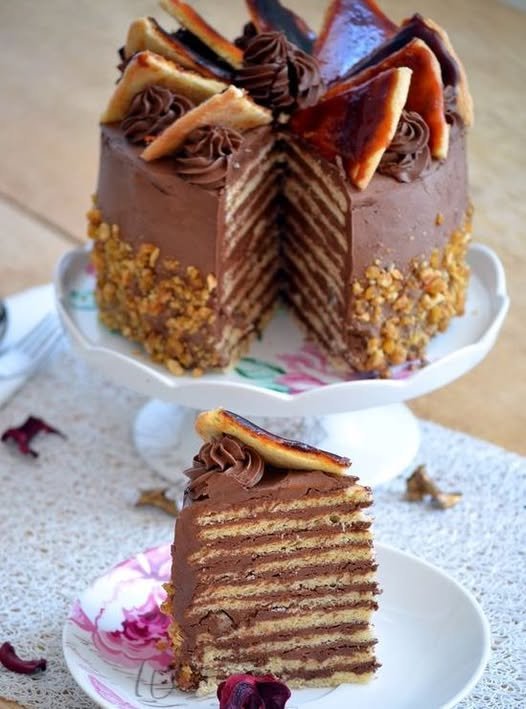
Few Hungarian desserts are as recognizable and impressive as the Dobos Torte. This elegant layered cake combines thin, delicate sponge cake with smooth chocolate buttercream and a beautifully crisp caramel layer on top.
Created in Budapest in the late 19th century by Hungarian confectioner József C. Dobos, the cake became famous for its distinctive construction and long-lasting qualities. Its signature caramel-covered sponge layer gives the cake its instantly recognizable appearance and adds a wonderful crisp contrast to the soft cake and creamy filling.
Although Dobos Torte looks like a pastry-shop masterpiece, you can make a homemade version with patience and careful preparation. The secret is to bake the sponge layers thin and evenly, prepare a silky chocolate buttercream, and handle the caramel layer quickly while it is still workable.
Why You’ll Love This Dobos Torte
- A classic Hungarian dessert
- Beautifully thin sponge cake layers
- Rich chocolate buttercream
- Signature crisp caramel topping
- Elegant enough for celebrations
- A wonderful make-ahead dessert
- Impressive presentation without complicated decorations
Ingredients
For the Sponge Layers
- 6 large eggs, separated
- ¾ cup granulated sugar
- 1 cup all-purpose flour
- 2 tablespoons cornstarch
- 1 teaspoon vanilla extract
- Pinch of salt
- 3 tablespoons unsalted butter, melted and cooled
- Butter or neutral oil, for greasing
For the Chocolate Buttercream
- 1 cup unsalted butter, softened
- 1 cup powdered sugar
- 6 oz (170 g) semisweet or dark chocolate
- 2 large egg yolks
- 1 teaspoon vanilla extract
- Pinch of salt
For the Caramel Top
- 1 cup granulated sugar
- 2 tablespoons water
- 1 teaspoon lemon juice
Optional Decoration
- Chocolate buttercream
- Toasted chopped hazelnuts
- Thin chocolate pieces
- Powdered sugar, for a very light finish
How to Make Hungarian Dobos Torte
Step 1: Prepare the Oven and Baking Sheets
Preheat the oven to 350°F (175°C).
Line several flat baking sheets or the bottom of a cake pan with parchment paper.
Traditional Dobos Torte is made from several very thin sponge layers rather than a few thick cake layers.
If you have multiple baking sheets, the process becomes much faster.
Step 2: Separate the Eggs
Separate the egg whites from the yolks carefully.
Place the egg whites in a clean, grease-free mixing bowl.
Place the yolks in another bowl.
Any traces of fat in the egg whites can make them difficult to whip properly.
Step 3: Beat the Egg Whites
Add the pinch of salt to the egg whites.
Beat on medium speed until they become foamy.
Gradually add about half of the sugar while continuing to beat.
Increase the speed and continue beating until the whites form glossy, firm peaks.
Set aside.
Step 4: Beat the Egg Yolks
In a separate bowl, beat the egg yolks with the remaining sugar and vanilla.
Continue mixing until the mixture becomes pale, thick, and creamy.
Step 5: Combine the Batter
Sift together the flour and cornstarch.
Gently fold the yolk mixture into the whipped egg whites.
Add the sifted flour mixture in several additions, folding gently after each addition.
Finally, fold in the melted butter.
Be careful not to overmix.
The goal is to maintain as much air as possible so the sponge remains light.
Step 6: Bake the Thin Sponge Layers
Spread the batter very thinly over the prepared parchment.
Aim for an even layer approximately ⅛ inch (3 mm) thick.
Bake for approximately 6–9 minutes, depending on your oven and the thickness of the sponge.
The layers should be lightly golden and spring back gently when touched.
Do not overbake them because thin sponge layers can dry out quickly.
Remove from the oven and immediately loosen the edges.
Allow the layers to cool.
Repeat until you have approximately 6–8 thin sponge layers.
Step 7: Trim the Layers
Once the sponge layers have cooled, place a cake ring, plate, or template over them.
Trim each layer into an even circle.
A cake approximately 8 inches (20 cm) in diameter works well for this recipe.
Keep the scraps rather than throwing them away. They can be used for crumbs or enjoyed as a snack.
Make the Chocolate Buttercream
Step 8: Melt the Chocolate
Break the chocolate into small pieces.
Melt it gently over a double boiler or in short microwave intervals.
Stir until smooth.
Allow it to cool until lukewarm but still fluid.
Step 9: Prepare the Buttercream
Beat the softened butter until smooth and creamy.
Gradually add the powdered sugar and continue beating until fluffy.
Add the egg yolks one at a time, mixing well after each addition.
Add vanilla and salt.
Slowly pour in the melted chocolate while mixing.
Continue beating until the buttercream is smooth, glossy, and spreadable.
If the buttercream seems too soft, refrigerate it briefly.
Step 10: Assemble the Cake
Place one sponge layer on a serving plate.
Spread a thin, even layer of chocolate buttercream over it.
Place another sponge layer on top.
Repeat the process until all but one sponge layer has been used.
Try to keep the buttercream layers relatively even.
This creates the classic striped appearance when the cake is sliced.
Set the final sponge layer aside for the caramel topping.
Prepare the Signature Caramel Layer
Step 11: Make the Caramel
Place the sugar, water, and lemon juice in a small heavy-bottomed saucepan.
Heat over medium heat.
Allow the sugar to dissolve and then continue cooking until the mixture turns a deep golden amber color.
Avoid stirring once the mixture begins to caramelize. You can gently swirl the pan instead.
Watch carefully because caramel can go from golden to burnt very quickly.
Step 12: Caramelize the Final Sponge
Place the reserved sponge layer on a sheet of parchment paper.
Quickly pour the hot caramel over the sponge and spread it into a thin, even layer using a lightly oiled spatula.
Work quickly because the caramel sets rapidly.
Important Caramel Safety
Hot caramel can cause severe burns.
Keep children away from the cooking area, avoid touching the caramel, and use heat-resistant utensils.
Step 13: Cut the Caramel Layer
Before the caramel completely hardens, use a lightly buttered or oiled sharp knife to score the caramel layer into individual wedges.
This makes the final cake much easier to serve.
Allow the caramel to cool and harden completely.
Step 14: Finish the Cake
Spread a thin layer of chocolate buttercream around the sides of the cake.
Use additional buttercream to create decorative peaks or rosettes around the top edge.
Arrange the caramel wedges around the top of the cake.
The traditional presentation often features caramel-topped wedges standing at an angle around the cake.
Refrigerate the cake until the buttercream is firm.
Before serving, allow it to sit at room temperature for approximately 20–30 minutes.
Recipe at a Glance
Prep Time: 1 hour
Bake Time: 30–45 minutes
Assembly Time: 30 minutes
Chilling Time: 2–4 hours
Total Time: About 4–6 hours
Servings: 10–12
Course: Dessert
Cuisine: Hungarian
Method: Oven + stovetop
Tips for Perfect Dobos Torte
Spread the Sponge Very Thinly
The defining characteristic of Dobos Torte is its thin sponge layers. Thick layers will make the finished cake feel more like a standard layer cake.
Measure the Layers
Using a template or cake ring helps ensure every sponge layer has the same diameter.
Don’t Overbake
Thin sponge layers cook extremely quickly. Remove them as soon as they are lightly golden and set.
Cool the Chocolate Before Adding It
Very hot melted chocolate can soften the buttercream too much. Allow it to cool until lukewarm before incorporating it.
Use Room-Temperature Butter
Soft butter blends much more smoothly into the buttercream.
Make the Caramel Last
Caramel hardens quickly, so prepare it only after the cake is assembled and you’re ready to finish the top.
Common Mistakes to Avoid
Making thick sponge layers: The cake loses its traditional delicate texture.
Overbaking the sponge: Thin layers can become dry and brittle.
Using cold butter: Cold butter can produce a lumpy buttercream.
Adding hot chocolate to the buttercream: This can melt the butter and make the filling too loose.
Cooking the caramel too far: Very dark caramel can taste bitter.
Waiting too long to cut the caramel: It becomes difficult to divide once completely hardened.
Variations
Dark Chocolate Dobos Torte
Use bittersweet or dark chocolate for a deeper chocolate flavor.
Hazelnut Dobos Torte
Add finely ground toasted hazelnuts to the buttercream or decorate the sides with chopped hazelnuts.
Coffee Chocolate Buttercream
Add 1–2 teaspoons of instant espresso powder to the melted chocolate for a subtle coffee flavor.
Orange Chocolate Dobos Torte
Add finely grated orange zest to the buttercream for a bright citrus note.
How to Store Dobos Torte
Store the finished cake covered in the refrigerator.
It is best enjoyed within 3–4 days.
Allow the cake to sit at room temperature for about 20–30 minutes before serving so the buttercream becomes softer and creamier.
Because the caramel top can gradually absorb moisture from the cake, the signature crunch is best during the first day or two.
Can You Make Dobos Torte Ahead?
Yes.
The sponge layers can be prepared a day ahead and stored carefully at room temperature in an airtight container.
The chocolate buttercream can also be prepared ahead and refrigerated.
Allow refrigerated buttercream to soften before spreading and beat it briefly to restore its smooth consistency.
For the best caramel texture, prepare the caramel-topped layer on the day you plan to serve the cake.
Frequently Asked Questions
How many layers does a traditional Dobos Torte have?
The number can vary, but a classic Dobos Torte is known for having multiple thin sponge layers separated by chocolate buttercream, often around six to eight layers.
Why is Dobos Torte topped with caramel?
The caramel layer is one of the cake’s defining characteristics. It provides a crisp texture and contrasts beautifully with the soft sponge and creamy buttercream.
Can I use a regular cake pan?
Yes. You can use a round cake pan or baking sheets, but the batter must be spread very thinly to create the characteristic sponge layers.
Can I use store-bought cake layers?
For convenience, you could, but traditional Dobos Torte depends heavily on its thin sponge layers. Homemade layers provide the most authentic texture.
Why did my sponge layers crack?
They may have been overbaked or allowed to cool uncovered for too long. Thin layers should remain flexible enough to handle during assembly.
Why is my buttercream too soft?
The butter may have become too warm, or the melted chocolate may have been too hot. Refrigerate the buttercream briefly, then whip it again before assembling.
Can I skip the caramel?
You can, but caramel is an important part of the classic Dobos Torte. Without it, you’ll have a delicious chocolate layer cake but not the traditional finishing element.
Final Thoughts
Hungarian Dobos Torte is a true celebration cake. Its thin golden sponge layers, silky chocolate buttercream, and crisp caramel topping create a combination of textures that makes every slice special.
It does require more patience than an ordinary layer cake, particularly when preparing the thin sponge sheets and caramel topping. However, the finished result is worth the extra effort.
For the best outcome, focus on three things: thin and evenly baked sponge layers, smooth chocolate buttercream, and carefully prepared caramel. Take your time during assembly, chill the cake thoroughly, and allow it to soften slightly before serving.
Once sliced, the beautiful layers reveal exactly why this classic Hungarian dessert has remained so recognizable for generations.
SEO Details
SEO Title: Hungarian Dobos Torte Recipe – Classic Chocolate Layer Cake
Meta Description: Learn how to make Hungarian Dobos Torte with thin sponge layers, rich chocolate buttercream, and the signature crisp caramel topping.
Focus Keyphrase: Hungarian Dobos Torte
Suggested Slug: hungarian-dobos-torte