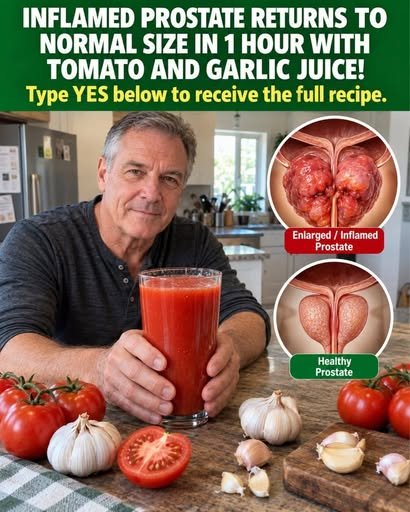
The idea of drinking one glass of tomato-garlic juice and watching an enlarged or inflamed prostate “snap back to normal size” in just one hour sounds appealing—but it isn’t supported by current medical evidence.
Tomatoes and garlic are nutritious foods containing a variety of plant compounds, and both can certainly be part of a balanced diet. Tomatoes provide lycopene, while garlic contains sulfur-containing compounds and other bioactive substances.
However, there is currently no good evidence that a glass of tomato-garlic juice can shrink an enlarged prostate within an hour.
It is important to distinguish between supporting overall nutrition and treating a prostate condition.
First: An Inflamed Prostate Is Not Always an Enlarged Prostate
Two terms are sometimes used interchangeably online even though they can describe different problems.
Prostatitis means inflammation of the prostate. Some forms are caused by bacterial infection, while others are not.
Benign prostatic hyperplasia (BPH) is a noncancerous enlargement of the prostate that becomes increasingly common with age.
The symptoms can overlap, including:
- Frequent urination
- Urgent need to urinate
- Weak urine stream
- Difficulty starting urination
- Dribbling
- Waking frequently during the night to urinate
- Feeling that the bladder has not emptied completely
Prostatitis can also cause pelvic, genital, lower abdominal, or lower-back discomfort, and bacterial prostatitis may cause fever and chills.
That distinction matters because the appropriate treatment depends on the underlying condition.
What Does Tomato Add?
Tomatoes are one of the best-known dietary sources of lycopene, a carotenoid responsible for their red color.
Lycopene has attracted scientific interest because of its antioxidant properties and its possible relationship with prostate health.
But an important limitation remains: the National Center for Complementary and Integrative Health says there is insufficient evidence to support lycopene for preventing or treating BPH.
So tomatoes can absolutely be part of a nutritious diet, but they shouldn’t be described as a rapid prostate-shrinking treatment.
What About Garlic?
Garlic is another nutritious ingredient that has been studied for a variety of health purposes.
It contains sulfur-containing compounds and can add substantial flavor to foods without requiring large amounts of salt.
However, there is no established evidence that drinking raw garlic juice rapidly reduces prostate enlargement.
Garlic can also cause abdominal discomfort, gas, nausea, and strong breath or body odor in some people. Garlic supplements may increase bleeding risk, particularly when combined with anticoagulants or aspirin.
For most people, using garlic as a normal food ingredient is a more reasonable approach than consuming concentrated amounts as a supposed prostate treatment.
A Simple Tomato-Garlic Drink
If you enjoy the combination, you can make a simple savory drink as part of your diet.
Ingredients
- 2 ripe tomatoes
- 1 small garlic clove
- ½ cup cold water
- 1 teaspoon lemon juice, optional
- A small pinch of black pepper
- A few fresh basil or parsley leaves, optional
Directions
Wash the tomatoes thoroughly and cut them into chunks.
Add the tomatoes, garlic, water, lemon juice, and black pepper to a blender.
Blend until smooth.
If you prefer a thinner drink, add a little more water.
For a milder garlic flavor, start with half a small clove rather than a whole clove.
Important Note
This drink should be viewed as a nutritious food beverage, not as a treatment for an enlarged or inflamed prostate.
There is no established amount or timing that makes tomato-garlic juice capable of shrinking the prostate in one hour.
Can an Enlarged Prostate Really Shrink?
Yes, some medical treatments can reduce prostate size—but this generally does not happen within an hour.
For certain men with BPH, medications such as finasteride or dutasteride can reduce prostate growth and actually shrink the prostate over time. NIDDK lists these medications among treatments for BPH.
Other treatments can improve urinary symptoms without necessarily shrinking the prostate.
The appropriate choice depends on prostate size, symptoms, medical history, and other factors.
What If the Problem Is Prostatitis?
If the prostate is inflamed because of a bacterial infection, drinking tomato-garlic juice is not a substitute for medical treatment.
NIDDK explains that bacterial prostatitis is treated with antibiotics. Other forms of prostatitis may require different approaches depending on the cause and symptoms.
This is especially important if urinary symptoms occur together with:
- Fever
- Chills
- Body aches
- Painful urination
- Pelvic pain
- Difficulty emptying the bladder
These symptoms should not be treated as simply a nutritional issue.
When to Seek Medical Attention
Don’t rely on a homemade drink if urinary symptoms are persistent or getting worse.
A healthcare professional can determine whether the symptoms are related to BPH, prostatitis, a urinary infection, medication effects, or another condition.
If you suddenly cannot urinate at all, seek medical attention promptly. NIDDK specifically identifies inability to urinate as a reason to get medical help right away.
Better Ways to Support Urinary Health
For men experiencing mild urinary symptoms, lifestyle measures may sometimes help.
Depending on the individual situation, these can include:
- Reducing large amounts of fluid before bedtime
- Limiting caffeine if it worsens urgency or frequency
- Limiting alcohol
- Staying physically active
- Reviewing medications that may affect urination with a healthcare professional
- Following a balanced diet
- Getting persistent symptoms evaluated
NIDDK lists these types of lifestyle measures among approaches that may help with mild BPH symptoms.
The Bottom Line
One glass of tomato-garlic juice cannot be shown to shrink an enlarged prostate to normal size in one hour.
Tomatoes provide lycopene and garlic provides a variety of plant compounds, making both reasonable foods in a balanced diet. But current evidence is not strong enough to recommend lycopene as a treatment for BPH, and tomato-garlic juice has not been established as a rapid prostate treatment.
If you’re experiencing urinary symptoms, the most important step is identifying what’s actually causing them. BPH, prostatitis, urinary infections, and other prostate or bladder problems can require very different treatments.
Food can support a healthy lifestyle, but it shouldn’t replace appropriate medical care when prostate symptoms are significant or persistent.
SEO Title
Inflamed Prostate? Can Tomato-Garlic Juice Really Help?
Meta Description
Can one glass of tomato-garlic juice shrink an enlarged prostate in one hour? Learn what tomatoes, lycopene, and garlic can realistically do for prostate health.
Focus Keyphrase
tomato garlic juice for prostate
Suggested Slug
tomato-garlic-juice-for-prostate