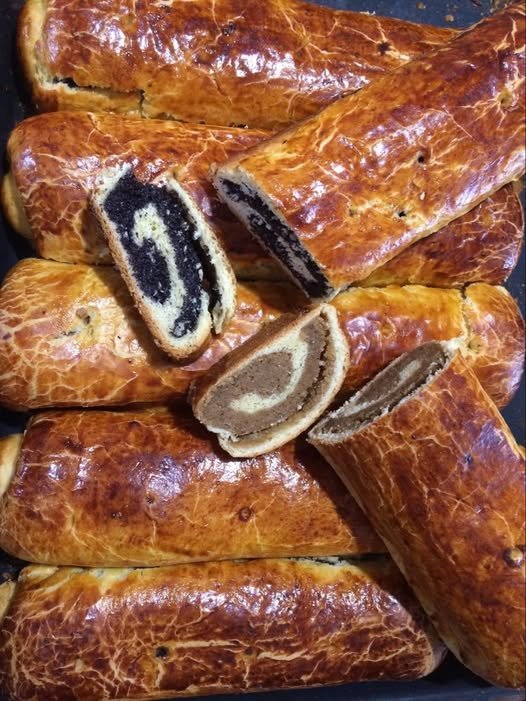
Hungarian Beigli is a classic festive pastry made from a rich, buttery yeast dough wrapped around a sweet walnut filling. Once baked, the roll develops a beautifully golden, slightly crisp exterior while the inside stays tender and packed with fragrant ground walnuts, sugar, cinnamon, and a hint of citrus.
Beigli is traditionally associated with Christmas in Hungary, but this delicious walnut roll is wonderful whenever you want something special to serve with coffee or tea.
The finished pastry looks impressive when sliced, revealing beautiful spirals of walnut filling inside. Although it takes a little patience to prepare, the ingredients are simple and the result is well worth the effort.
Why You’ll Love Hungarian Beigli
- Rich, buttery pastry with a tender crumb
- Generous walnut filling in every slice
- Warm cinnamon and citrus flavors
- Beautiful spiral appearance
- Perfect with coffee or tea
- Excellent for holidays and celebrations
- Can be prepared ahead of time
- Keeps well for several days
Ingredients
For the Pastry
- 3 cups all-purpose flour
- ¾ cup unsalted butter, softened
- ¼ cup granulated sugar
- 2 large egg yolks
- ½ cup whole milk, lukewarm
- 1½ teaspoons instant yeast
- ¼ teaspoon salt
- 1 teaspoon vanilla extract
- 1 teaspoon finely grated lemon zest
For the Walnut Filling
- 2 cups finely ground walnuts
- ¾ cup granulated sugar
- ½ cup milk
- 1 teaspoon ground cinnamon
- 1 teaspoon finely grated lemon zest
- 1 teaspoon vanilla extract
- 2 tablespoons raisins, optional
- 1 tablespoon honey, optional
For the Egg Wash
- 1 egg yolk
- 1 tablespoon milk
How to Make Hungarian Beigli
1. Prepare the Dough
In a small bowl, combine the lukewarm milk with the yeast and a teaspoon of the sugar.
Let it stand for about 5 minutes.
In a large mixing bowl, combine the flour, remaining sugar, and salt.
Add the softened butter and rub it into the flour using your fingertips until the mixture resembles coarse crumbs.
Add the egg yolks, vanilla, lemon zest, and yeast mixture.
Mix until a soft dough forms.
2. Knead the Dough
Turn the dough onto a lightly floured surface and knead gently for about 5–7 minutes.
The dough should become smooth and supple.
Be careful not to add too much flour. The pastry should remain relatively rich and tender rather than becoming stiff.
Shape the dough into a ball.
3. Chill the Dough
Place the dough in a lightly greased bowl and cover it.
Refrigerate for approximately 1 hour.
Chilling is important because the butter-rich dough becomes easier to roll and shape when cold.
4. Make the Walnut Filling
While the dough chills, prepare the filling.
Place the milk and sugar in a small saucepan.
Warm over medium heat, stirring until the sugar dissolves.
Add the ground walnuts, cinnamon, lemon zest, vanilla, and honey if using.
Stir until everything is well combined.
Cook for about 2–3 minutes until the mixture becomes thick.
If using raisins, stir them in at this stage.
Remove from the heat and allow the filling to cool completely.
The filling should be thick and spreadable rather than runny.
5. Divide and Roll the Dough
For two medium Beigli rolls, divide the chilled dough into two equal portions.
Place one portion on a lightly floured surface.
Roll it into a rectangle approximately 10 × 14 inches.
Try to keep the thickness even.
Spread half of the cooled walnut filling over the dough, leaving about ½ inch around the edges.
Don’t spread the filling all the way to the edges because it can squeeze out during rolling.
6. Roll the Beigli
Fold the short edges slightly inward.
Then carefully roll the pastry from one long side into a firm log.
Don’t roll it too loosely, but avoid squeezing the filling out.
Pinch the seam gently to seal it.
Place the roll seam-side down on a parchment-lined baking tray.
Repeat with the second piece of dough and remaining filling.
7. Prepare the Egg Wash
Whisk together the egg yolk and milk.
Brush the tops and sides of the rolls lightly with the egg wash.
For the traditional cracked Beigli appearance, allow the first coating to dry for about 15–20 minutes.
Then brush with another thin layer.
Using a skewer or toothpick, make several small holes through the top of each roll.
These small vents allow steam to escape during baking and can help reduce excessive cracking.
8. Bake
Preheat the oven to 350°F (175°C).
Bake the Beigli for approximately 30–40 minutes, or until beautifully golden brown.
The exact baking time will depend on the size and thickness of the rolls.
Don’t slice the rolls immediately after removing them from the oven.
Allow them to cool completely on a wire rack.
The Secret to Beautiful Beigli
Traditional Beigli is known for its characteristic marbled or cracked surface.
Don’t worry if your roll develops a few cracks while baking. In fact, slight cracking is common with this pastry.
The most important things are:
- Keep the filling thick rather than wet.
- Chill the dough before rolling.
- Don’t overfill the pastry.
- Roll the dough evenly.
- Avoid trapping excessive air inside.
- Make small steam holes before baking.
- Allow the finished rolls to cool completely before slicing.
Tips for Perfect Walnut Beigli
Grind the Walnuts Finely
Finely ground walnuts create a smooth filling that slices beautifully.
Avoid turning them into walnut butter. You want a fine, crumbly texture.
Cool the Filling Before Using
Warm filling can soften the butter-rich pastry and make it difficult to roll.
Let the filling cool until it is completely or almost completely cool.
Don’t Overwork the Dough
Beigli dough is meant to be tender and rich. Excessive kneading can make it tougher.
Roll Evenly
An evenly rolled rectangle helps produce a uniform spiral and prevents one end from being much thicker than the other.
Don’t Overbake
The pastry should be golden brown but not deeply dark.
Overbaking can make the crust unnecessarily hard.
Optional Additions to the Walnut Filling
Traditional family recipes can vary, and you can customize your Beigli with:
- Raisins
- Orange zest
- Lemon zest
- Vanilla
- Cinnamon
- Honey
- A small amount of finely chopped dried fruit
- A pinch of ground cloves
For a stronger citrus flavor, replace some of the lemon zest with orange zest.
Walnut vs. Poppy Seed Beigli
Hungarian Beigli is commonly prepared with either walnut or poppy seed filling.
The walnut version is rich, nutty, and warmly spiced.
The poppy seed version has a deeper, slightly earthy flavor and is another traditional festive variation.
You can use the same basic pastry dough for both.
How to Serve Beigli
Allow the rolls to cool completely before slicing them into approximately ½-inch slices.
Serve at room temperature with:
- Coffee
- Black tea
- Milk
- Hot chocolate
- A festive dessert platter
For a simple presentation, dust the cooled rolls lightly with powdered sugar.
Storage
Store completely cooled Beigli in an airtight container at room temperature for approximately 3–4 days.
For longer storage, refrigerate it for up to about a week.
Allow refrigerated slices to come to room temperature before serving for the best texture.
Can You Freeze Beigli?
Yes.
Wrap the completely cooled rolls tightly in plastic wrap and then place them in a freezer-safe bag or container.
Freeze for up to 2–3 months.
Thaw overnight in the refrigerator or at room temperature before serving.
Frequently Asked Questions
Why did my Beigli crack?
Cracking is actually quite common with Beigli. It can happen when the filling contains too much moisture, the roll is overfilled, air is trapped inside, or the dough and filling expand differently during baking.
Small cracks don’t mean the pastry has failed.
Can I use walnuts without cooking the filling?
You can, but cooking the filling with milk and sugar helps develop its flavor and gives it the proper consistency for rolling.
Can I make one large Beigli?
Yes, but two smaller rolls are generally easier to handle and bake more evenly.
Can I use brown sugar?
Yes. Brown sugar will give the filling a slightly deeper caramel-like flavor.
Can I make Beigli ahead of time?
Absolutely. Beigli is actually well suited to advance preparation because it keeps well once baked and cooled.
Why should I cool it before slicing?
The filling needs time to set. Cutting the pastry while it is hot can cause the filling to smear and the slices to lose their spiral shape.
Recipe at a Glance
Prep Time: 35 minutes
Chilling Time: 1 hour
Cooling/Rising Time: About 30 minutes
Bake Time: 30–40 minutes
Total Time: About 2½ hours
Yield: 2 walnut rolls
Oven Temperature: 350°F (175°C)
Final Thoughts
Hungarian Beigli is one of those traditional pastries that feels especially meaningful when shared around a family table. The combination of tender buttery pastry and sweet cinnamon-walnut filling creates a beautiful balance of richness and warmth.
Whether you’re making it for Christmas, a holiday gathering, or simply want to try a classic Hungarian bake, this walnut roll makes a wonderful homemade treat.
Slice it once completely cooled, serve it with a cup of coffee or tea, and enjoy every spiral of buttery pastry and fragrant walnut filling.
SEO Title
Hungarian Beigli – Traditional Hungarian Walnut Roll Recipe
Meta Description
Learn how to make Hungarian Beigli, a traditional buttery walnut roll with cinnamon, citrus, and a tender pastry crust. Perfect for Christmas and festive baking.
Focus Keyphrase
Hungarian Beigli Walnut Roll
Suggested Slug
hungarian-beigli-walnut-roll